Heidi M. Sosik Hui Feng
130 likes | 250 Vues
This project aims to utilize a unique time series from the New England Shelf to assess and extend MODIS ocean color data beyond just chlorophyll measurements, focusing on functional type and size-class-dependent phytoplankton retrievals. Using end-to-end observational approaches, the study evaluates algorithms through step-by-step analysis, including single cell phytoplankton communities and their impact on bulk water optical properties. The research integrates advanced tools such as AERONET-OC and submersible imaging flow cytometry to achieve taxonomically resolved phytoplankton observations and assess seasonal and interannual variability in response to environmental changes.


Heidi M. Sosik Hui Feng
E N D
Presentation Transcript
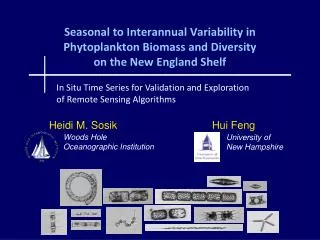
Seasonal to Interannual Variability in Phytoplankton Biomass and Diversity on the New England Shelf In Situ Time Series for Validation and Exploration of Remote Sensing Algorithms Woods Hole Oceanographic Institution University of New Hampshire Heidi M. SosikHuiFeng
Project Overview Goal: Use unique time series to evaluate algorithms that extend MODIS ocean color data beyond chlorophyll to functional type or size-class-dependent phytoplankton retrievals Approach: End-to-end time series observations, with step-by-step algorithm evaluation and error analysis single cells phytoplankton community bulk water optical properties sea surface optical properties (air and water) MODIS optical properties Martha’s Vineyard Coastal Observatory Tower mounted AERONET-OC Submersible Imaging Flow Cytometry MODIS products
Approach Phytoplankton Observations Single cells to communities Biomass, size- and taxon-resolved Phytoplankton Algorithms Absorption spectral shape size structure Diagnostic pigments size structure Diagnostic pigments taxonomic structure
Variability in community structure . m m Diatoms Cyano- bacteria m m m m m m m m
Pigment-based retrieval of taxonomic groups Diatoms In situ FCM “CHEMTAX” Mackey et al. 1996 Total Chl a = diatom Chl a + dinoflagellateChl a + cyanobacteria Chl a + … with partitioning according to accessory pigment ratios
Pigment-based retrieval of taxonomic groups Diatoms Dinoflagellates Cyanobacteria ~1 mm cells 10 mm
Diagnostic pigment retrieval from Rrs Pan et al. 2010 band ratio algorithms Chl a AERONET-OC SeaPRISM, Rrs(l) Discrete samples HPLC pigment analysis
Diagnostic pigment retrieval from Rrs Pan et al. 2010 band ratio algorithms Chl a Fucoxanthin Zeaxanthin
Seasonality – pigment retrievals Diatoms Cyano- bacteria Diatom indicator pigment Cyanobacteria indicator pigment
Ecosystem characterization Cyanobacterium Diatoms Taxa with positive response to warmer winters Taxa with negative response to warmer winters Interannual variability – taxon specific Seasonally adjusted Biomass anomalies vs Temperature anomalies
Ecosystem characterization Decadal increase in pico-cyanobacteria at MVCO Local detail Trends and patterns of change Regional to basin scales
http://ifcb-data.whoi.edu/ Open data access Standard formats Processing pipelines End-to-end provenance