Understanding Present Simple vs. Present Continuous in English
This guide explores the differences between Present Simple and Present Continuous tenses in English. The Present Simple tense expresses facts that are always true or habits, such as "He comes from Saudi Arabia" or "He goes to the gym every day." The guide covers the rules for forming the third-person singular. The Present Continuous tense describes actions occurring now or in the near future, illustrated by "She is wearing a dress." Learn how to properly conjugate verbs for each tense, including spelling rules for the present participle.

Understanding Present Simple vs. Present Continuous in English
E N D
Presentation Transcript
Present Simple vs. Present continues English 2 2014 Sumayah Abdulshakour Umm Al-Qura University/ Community college
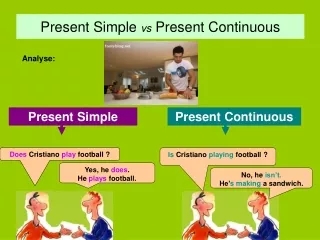
Present Simple 1- Expresses a fact which is always true or a true for a long time e.g. He comes from Saudi Arabia. 2- It expresses a habit e.g. He goes to the gym everyday.
Present Simple • Spelling of the third person singular: 1- most verbs add –s ( speak / Speaks). go and do are different they add –es (go/goes). 2- If the verb ends in –s,–shor –ch, add –es (watch/ watches). 3- If the verb ends in a consonant + -y, the y changes to –ies (fly/ flies). But if if ends in a vowel+ -y the –y doesn't change (play/plays). 4-Have is irregular (have/ has)
Present continuous • 1- it describes an activity happening now • E.g. She is wearing a dress 2- It describes and activity in the near future E.g. I’m playing football this afternoon.
Present continuous • Spelling of verb + -ing 1- most verbs just add –ing(go/going) 2- If the infinitive ends in –e, drop the –e (smile/smiling). 3- when a one-syllable verb has one vowel and ends in a consonant (get/ getting)