Understanding Exception Handling in Java: A Code Example
This example illustrates exception handling in Java, using a custom exception class `MyEx` within a main method. The code demonstrates how to manage risky operations with try-catch-finally blocks, showcasing output based on the input argument. Specifically, if the input is "yes", a custom exception is thrown, while "no" outputs a different result. This foundational concept is critical for robust Java programming, as it allows developers to predict, handle, and respond to errors during runtime effectively.

Understanding Exception Handling in Java: A Code Example
E N D
Presentation Transcript
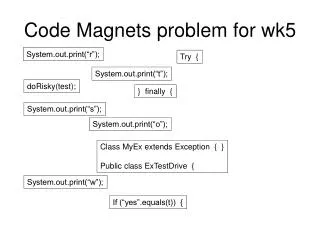
Code Magnets problem for wk5 System.out.print(“r”); Try { System.out.print(“t”); doRisky(test); } finally { System.out.print(“s”); System.out.print(“o”); Class MyEx extends Exception { } Public class ExTestDrive { System.out.print(“w”); If (“yes”.equals(t)) {
Code Magnets problem for wk5 (cont) throw new MyEx(); System.out.print(“a”); } catch (MyEx e) { Static void doRisky(String t) throws MyEx { System.out.print(“h”); Public static void main (String [] args) { String test = args[0]; Output: Java ExTestDrive yes thaws Java ExTestDrive no throws