
Understanding Parallelograms: Properties, Diagonals, and Angle Relationships
E N D
Presentation Transcript
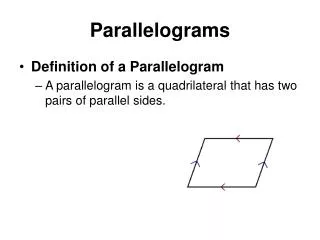
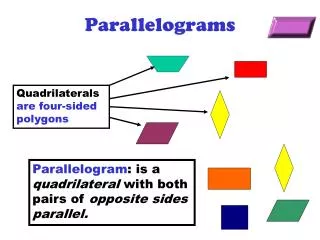
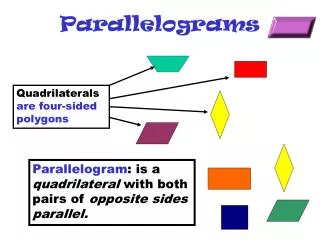
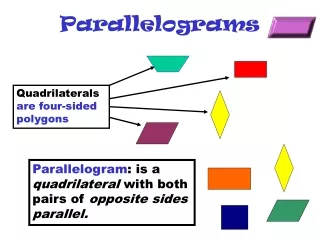
B C D A Parallelogram A quadrilateral whose opposite sides are parallel.
B C D A Properties of Parallelograms Opposite sides are congruent.
B C D A Properties of Parallelograms Opposite angles are congruent.
B C D A Properties of Parallelograms Consecutive angles are supplementary
B C D A Properties of Parallelograms Diagonals bisect each other
H K Examples M P L • Draw HKLP. • If HK = _______ and HP = ________ . • m<K = m<______ . • m<L + m<______ = 180. • If m<P = 65, then m<H = ____,m<K = ______ and m<L =____. • Draw in the diagonals. They intersect at M. • If HM = 5, then ML = ____ . • If KM = 7, then KP = ____ . • If HL = 15, then ML = ____ . • If m<HPK = 36, then m<PKL = _____ . PL KL P P or K 115° 65 115° 5 units 14 units 7.5 units alternate interior angles are congruent. 36;