Understanding Body Mass Index (BMI): Definition, Calculation, and Usage
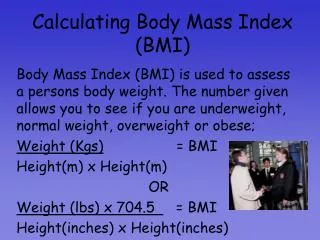
The Body Mass Index (BMI), also known as the Quetelet Index, is a heuristic measure that estimates human body fat based on weight and height. Developed by Belgian polymath Adolphe Quetelet between 1830 and 1850, BMI serves as a useful tool in medicine, providing a standardized way to assess body weight categories. It is calculated by dividing an individual's weight (in kilograms) by the square of their height (in meters), yielding units of kg/m². BMI can also be visualized using a BMI chart, which displays various BMI values categorized by weight and height.

Understanding Body Mass Index (BMI): Definition, Calculation, and Usage
E N D
Presentation Transcript
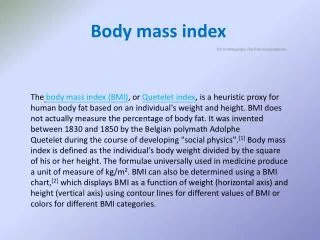
The body mass index (BMI), or Quetelet index, is a heuristic proxy for human body fat based on an individual's weight and height. BMI does not actually measure the percentage of body fat. It was invented between 1830 and 1850 by the Belgian polymath AdolpheQuetelet during the course of developing "social physics".[1] Body mass index is defined as the individual's body weight divided by the square of his or her height. The formulae universally used in medicine produce a unit of measure of kg/m2. BMI can also be determined using a BMI chart,[2] which displays BMI as a function of weight (horizontal axis) and height (vertical axis) using contour lines for different values of BMI or colors for different BMI categories. • 資料來源http://en.wikipedia.org/wiki/Body-mass-index