Bacterial genetics
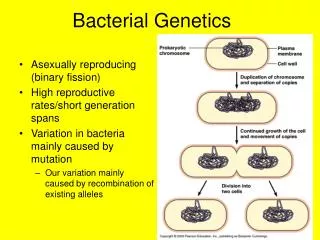
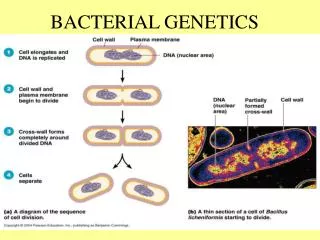
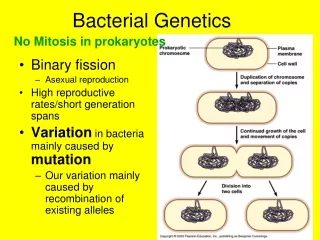
Bacterial genetics. Growth and Division. The rate at which bacteria grow and divide depends in large on the nutritional status of the environment Division is by binary fission

Bacterial genetics
E N D
Presentation Transcript
Growth and Division • The rate at which bacteria grow and divide depends in large on the nutritional status of the environment • Division is by binary fission DNA replication: Replication of the DNA is a precise process resulting in each daughter cell acquiring an exact copy of the parental genome • Initiation: Begins at a site on the chromosome called origin of replication • unwinding of the DNAs to separate into two strands • Enzymes – called helicase and topoisomerase (e.g. DNA gyrase) are utilized • Elongation • Separated DNA strands each serve as a template for DNA polymerase • incorporation of deoxyribonucleotides to form complementary DNA strand which correctly base pair with the template DNA • The two copies of the total genome produced during replication • comprise one parental strand and one newly synthesized strand of DNA • Termination: specialized termination zone ; specialized binding proteins stall the replication process Formation of Daughter cells • 2 chromosomes segregate, cell wall septum forms between them • Division to give 2 daughter cells
Bacterial genetic material DNA: where? • Chromosome • Circular, double stranded DNA • Contains essential genes for replication, metabolism • Single copy per cell • Haploid (one copy of each gene) • Plasmids • Transposons • Bacteriophages
Plasmids • Extrachromosomal genetic material • Replicate autonomously • Circular, double stranded DNA • Multiple copies may be present • Can be gained or lost from a bacterial cell • Plasmids contain genes for • replication • mediating their own transfer between bacteria (tra- genes) • variety of additional functions e.g. • resistance to antimicrobials • resistance to toxic metals • bacteriocin production • toxin production
Classification of plasmids by function • Fertility-(F-) plasmids • contain only tra-genes. • function is to initiate conjugation • Resistance-(R-)plasmids, • which contain genes for antibiotic resistance • Col-plasmids • contain genes that code for colicines (bacteriocins) -proteins that can kill other bacteria • Degradative plasmids • genes for the digestion of organic compounds & other unusual substances e.g toluene & salicylic acid • Virulence plasmids • Genes for virulence factors
Transposons • “Jumping genes” • Small segments of DNA • jump from one chromosomal site • Move from chromosome into a plasmid • May carry genes for antibiotic resistance • When they land in a gene they may alter its function therefore cause mutation
Bacteriophages • Viruses that infect bacterial cell • Consists of a protein coat or head (capsid) which surrounds nucleic acid which may be • Genome is either DNA or RNA – never both
Lifecycle of Bacteriophages • 2 pathways • Virulent pathway:- • Takes over the protein synthesis machinery of the cells for viral replication • Formation of new virus particles • Release of new viruses cell lyses • Lysogenic pathway:- • Occurs in temperate bacteriophages • integrate with bacterial chromosome & replicate within the bacterial chromosome • prophage state • result in expression of new characteristics by the cell • Under adverse conditions, prophages are activated & go into the lytic pathway
Regulation of gene expression • Bacteria adopt to their environment by controlling gene expression • Show a remarkable ability to adopt to changes in their environment • Predominantly achieved by controlling gene expression – ensuring when and for what proteins are produced • Most common way of altering gene expression is to change the amount of mRNA transcription • Expression of many virulence determinants are highly regulated
Regulation of gene expression • Inducible genes: • expression is turned on by the presence of some substance • Examples • Lactose induces expression of the lac genes • An antibiotic induces the expression of a resistance gene • Repressible genes • expression is turned off by the presence of some substance (co-repressor) e.g. Tryptophan represses the trp genes
MUTATION • Any change in structure of the genetic material (sequence of the DNA) • Mutation can occur:- • spontaneously or • by a variety of chemicals (mutagens) • Mutation can be:- • Unstable: frequently revert to original state • Stable: causes some changes in the characteristic of the organism • Lethal: cell unable to tolerate the loss of function & die
Mutation at the level of the organism • Auxotrophic or Nutritional mutants: • Mutation occurs in a biosynthetic gene • cell will not grow unless missing nutrient is provided – auxotrophs • Temperature sensitive mutant: • Gene expression will only occur at particular temperature
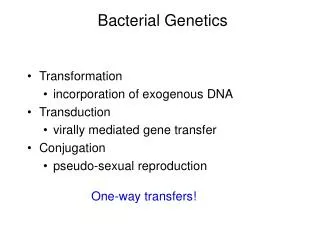
Gene transfer and recombination • New genotypes arise when genetic material is transferred from one bacterium to another • Transferred DNA can • Recombine with the genome of the recipient cell • Remain on self replicating plasmid • DNA can be transferred from donor cell to a recipient cell by:- • transformation • transduction • conjugation • transposition
Transformation • Uptake of free DNA present in the environment • Short pieces of the DNA • Integrated into recipient chromosome
Transduction Transfer of genetic material via bacteriophage
Conjugation • Transfer of genetic material via plasmids • encode for the bacterial cell to produce a sex pilli • The donor or male cell makes contact with the recipient cell or female cell • DNA is transferred from one bacterium to another