Download
1 / 29
370 likes | 603 Vues
This article explores the unique aspects of bacterial genetics, emphasizing the absence of mitosis in prokaryotes and the process of binary fission as a means of asexual reproduction. It discusses the high reproductive rates of bacteria and the main sources of genetic variation, including mutations and genetic recombination through transduction, transformation, and conjugation. The roles of plasmids and operons in gene expression regulation, focusing on models like the lac and trp operons, are also examined. This provides insight into bacterial adaptability and survival strategies.

E N D
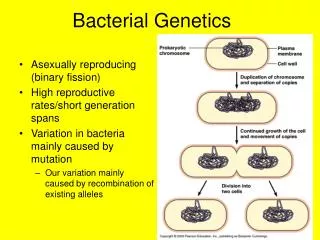
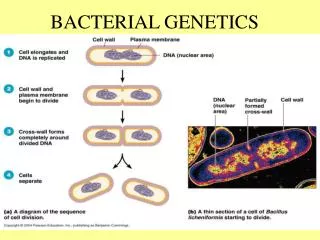
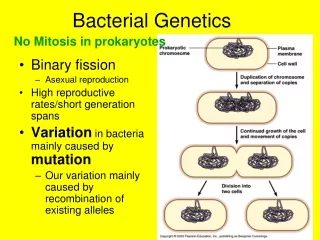
Bacterial Genetics No Mitosis in prokaryotes • Binary fission • Asexual reproduction • High reproductive rates/short generation spans • Variation in bacteria mainly caused by mutation • Our variation mainly caused by recombination of existing alleles
Sources of genetic recombination: Although there is no meiosis, recombination of alleles can occur • Transduction • Transformation • Conjugation
Transduction • Viruses may transfer (act as vector) DNA from one bacteria to another • New bacterial DNA may line up with a homologous section of the bacterial chromosome and recombination (crossing over) may occur • May be GENERALIZED TRANSDUCTION or SPECIALIZED TRANSDUCTION
Generalized transduction • Virus is in the lytic cycle • Bacterial DNA that was degraded accidentally is incorporated into viral capsid • Capsid injects bacterial DNA into new bacteria • The genes transferred are random
Specialized transduction • Occurs from temperate viruses (in lysogenic cycle) • Prophage comes out of bacterial chromosome and take adjacent genes with it • Only specific genes are transferred in this way
Conjugation • Bacterial “Sex” • Many bacteria have plasmids • Small circular pieces of DNA separate from chromosome • Contain only a few genes • Not necessary to bacteria’s survival • May give an advantage under certain environmental conditions
F plasmids • Fertility plasmids • Have genes that allow bacteria to form sex pilli
F plasmid • Plasmids are transferred through the sex pilus during conjugation • A copy of plasmid is first made then transferred • F+ transfers to F-
R plasmid • Plasmid containing genes that make bacterial RESISTANT to antibiotics • May have up to 10 antibiotic resistance genes on one plasmid
Regulation of gene expression in prokaryotic cells Operons Set of structural genes that are have one promoter and are controlled by one operator Operator determines whether transcription occurs Regulatory gene codes for repressor
trp operon This is a repressible operon The repressor is made in its inactive form Operon is naturally “on” A corepressor is required to activate the repressor and turn the operon “off”
The regulatory gene codes for the regulatory protein which is a repressor molecule
Active repressor prevents transcription The repressor is MADE in its ACTIVE form The operon is in its “OFF” position
The operator determines whether transcription will occur by being able to bind with a regulatory protein
The concentration of glucose is inversely proportional to the concentration of cyclic AMP Cyclic AMP binds with an activator protein and helps RNA polymerase to bind to the promoter