Download
1 / 24
240 likes | 272 Vues
This course focuses on designing effective learning experiences by considering various teaching styles, learning preferences, and course contexts. Explore course planning, content selection, and activity design to cater to different learning styles and goals.

E N D
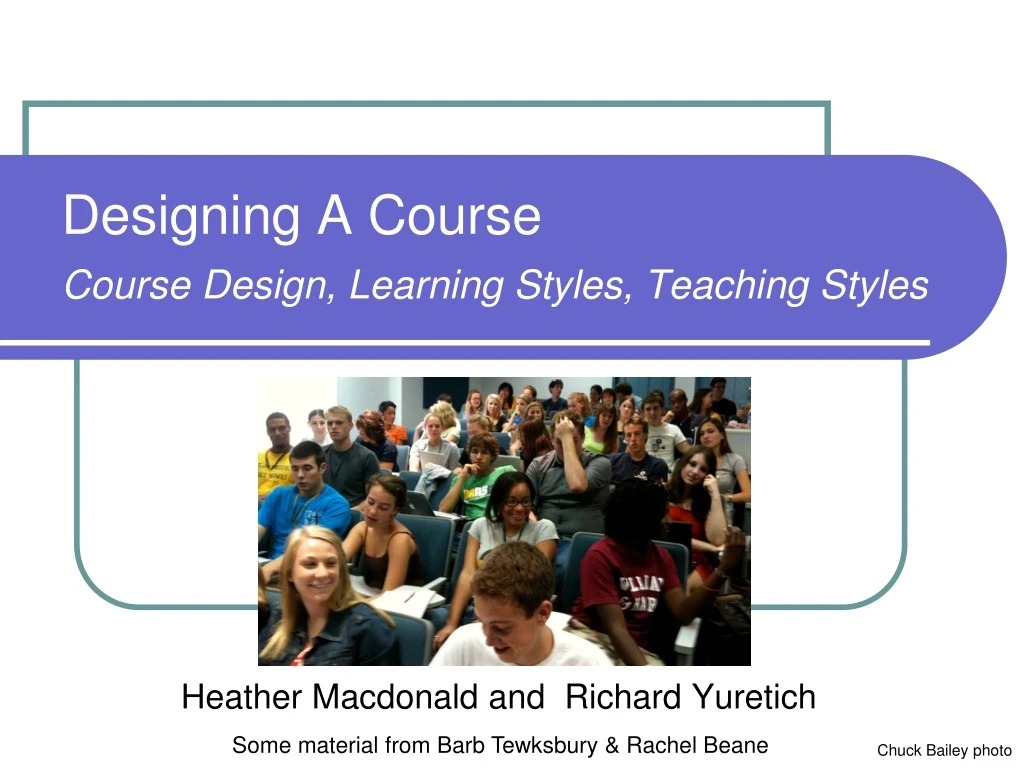
Designing A CourseCourse Design, Learning Styles, Teaching Styles Heather Macdonald and Richard Yuretich Some material from Barb Tewksbury & Rachel Beane Chuck Bailey photo
Focus on one of your courses Viewpoint • Content-centered • What will I cover? • Learner-centered • What will they learn?
One Course Design Process • Consider course context and audience • Articulate course goals • Develop a course plan • Select content topics • Design activities and assignments • Plan assessment http://serc.carleton.edu/NAGTWorkshops/coursedesign/tutorial/index.html
Consider Course Context and Audience • General education course? Majors course? • Required? Elective? • Size of course? • Who are the students? • What do they want to learn? • How do they learn?
Learning Styles How does the student prefer to process information? • Actively – through engagement in physical activity or discussion • Reflectively – through introspection Questionnaire - Barbara Soloman & Richard Felder http://www.engr.ncsu.edu/learningstyles/ilsweb.html
Your Learning Styles (n=39) 23 16 Active Reflective For comparison: Active 60%; Reflective 40%
Learning Styles What type of information does the student preferentially perceive? • Sensory – sights, sounds, physical sensations, data … • Intuitive – memories, ideas, models, abstract …
Your Learning Styles (n=39) For comparison: Sensing 65%; Intuitive 35% 20 19 Sensing Intuitive
Learning Styles How does the student most effectively perceive sensory information? • Visual – pictures, diagrams, graphs, demonstrations, field trips • Verbal – sounds, written and spoken words, formulas
Your Learning Styles (n=39) For comparison: Visual 80%; Verbal 20% 35 4 Visual Verbal
Learning Styles How will the student progress toward understanding? • Sequentially – in logical progression of small incremental steps • Globally – in large jumps, holistically
Your Learning Styles For comparison: Sequential 60%; Global 40% 16 23 Sequential Global
Learning Styles • Different students will learn most effectively in different ways • We can teach in ways that address a broad spectrum of learning styles 2007 workshop participants
Designing a Course • Consider course context and audience • Articulate course goals • Overarching goals • Ancillary goals • Writing, oral communication, working in a team, quantitative, research, field, lab… • Develop a course plan
Overarching Goals What do you want students to be able to doas a result of having taken your course? • What do you do? • What kinds of problems do you want students to be able to tackle? • How might students apply what they have learned? • How will they be different at the end of the course?
Evaluate Overarching Goals • Does the goal focus on higher-order thinking (e.g. derive, predict, analyze, design, interpret, synthesize, formulate, plan, correlate, evaluate, create, critique and adapt)? • Is the goal student-focused, rather than teacher-focused? • Does the goal have “measurable outcomes?” Could you design activities/assignments that would allow you to determine whether students have met the goal? • Examples: • I want students to synthesize the geologic history of the Virginia coastal plain • I want to provide students with an introduction to global climate change • I want students to look at outcrops/weather maps/…differently after taking my course
Consider a course that you will be teaching… What are your overarching goals? Please write your course title and 1-3 goals. For the goals, consider “When students have completed my course, I want them to be able to…”
Evaluate Overarching Goals • Consider whether the goal focuses on higher order thinking skills? • is student centered? • has a measurable outcome?
Designing a Course • Consider course context and audience • Articulate course goals • Develop a course plan • Select content topics • Design activities and assignments • Plan assessment
Select content topics to achieve course goals • Students will be able to research and evaluate news reports of a natural disaster and communicate their analyses to someone else • Instructor #1: Four specific disasters • Earthquake and tsunami in Japan • Landslides in coastal California • Floods in the midwest • Mt. St. Helens • Instructor #2: Four themes • Impact of hurricanes on building codes and insurance • Perception and reality of fire damage on the environment • Mitigating the effects of volcanic eruptions • Geologic and sociologic realities of earthquake prediction
Designing Activities Often many ways to design an activity to meet a goal. If I want students to be able to analyze map data, I might: • Prepare a Gallery Walk of maps around the classroom • Ask a series of directed questions about a map (in lecture or as homework) • Have students prepare clay models of topo maps and share them with the class • Ask students to complete an interpretative cross-section during lab • Have students prepare a map of their hometown using GIS and identify possible hazards Provide repeated opportunities to practice, with feedback.
Assessment: Many Possibilities http://serc.carleton.edu/NAGTWorkshops/assess/types.html
Teaching Styles: Who are you? • Why do you teach? • How do you like to teach? • How do you want to interact with your students? • What do you find most satisfying when you teach? • How flexible are you?
Context for Today’s Sessions • Students have different learning styles • Articulate learning goals when designing courses • Design and adapt activities with learning goals in mind • Expand your “toolbox” of teaching and assessment strategies