USPS Capital Investment Plan: Ensuring Long-Term Viability and Financial Fitness
The USPS is developing a workable plan to fund essential capital investments for its long-term viability. Key aspects include addressing the decline in First-Class Mail volume, optimizing its capital investment strategy, and implementing cost reduction efforts. The Capital Investment Plan encompasses up to $3.2 billion annually to enhance infrastructure, equipment, and facilities. The USPS has successfully achieved $11.8 billion in savings while focusing on service improvements and workforce flexibility. Continued support and innovation are vital for transitioning towards a sustainable future.

USPS Capital Investment Plan: Ensuring Long-Term Viability and Financial Fitness
E N D
Presentation Transcript
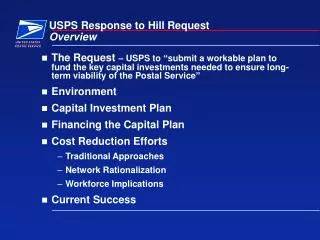
USPS Response to Hill RequestOverview • The Request – USPS to “submit a workable plan to fund the key capital investments needed to ensure long-term viability of the Postal Service” • Environment • Capital Investment Plan • Financing the Capital Plan • Cost Reduction Efforts • Traditional Approaches • Network Rationalization • Workforce Implications • Current Success
Environment • Declining FCM volume and contribution • 1.9 new delivery points per year • Volume has become more difficult to forecast – less dependent on economy, more diversion. • Worksharing has increased bringing more mail to destination, bypassing origin processing and transportation
Capital Investment Plan • Total Draft Capital Plan 2004-2010 -details to GAO • $2.4 – 3.2B per year, almost $19B over 7 years • Categories: • Auto/Mech – letters, flats, parcels, material handling, and infrastructure support (IT) sub-categories • Vehicles – maintain existing fleet • Retail Equip – POS and Automated Postal Centers • Facilities – customer service/admin, building improvement, major processing sub-categories • Postal Support and Emergency Preparedness – IT
Financing the Capital Plan • Depreciation is primary source • Part of test year revenue requirement • Capital freeze focused on facilities due to volume and workload declines, not generative capital Limited Options: • Sell Assets – Many smaller facilities are leased. Consistently selling assets. Yet need facilities where the mail and people are. Any one want to buy Chicago? • Borrow – statutory annual limits
Cost Reduction EffortsTraditional Approaches • Capital Equipment – PARS, OCR replacement, auto tray handling systems, etc. • BPI and standardization that does not require capital • The type of equipment is not dependent upon the network – shape related
Cost Reduction EffortsNetwork Optimization and Rationalization • 80% of large facilities are < 30 years old • Networks have changed many times over the years as mechanization / automation have improved – MSCs, BMCs, SDCs, ADCs, AADCs, PMPCs • Need for Change – multiple shape-based networks • A Promising Alternative – one network from many • Validate model – IG suggestedreview • Stakeholder input • Test concept(s) – those w/ and w/o facility changes • Incremental approach – do not want a PMPC repeat
Cost Reduction EffortsWorkforce Flexibility • Attrition Rates: 5.8 - 4.4 percent/year • Retirement Eligibility • 110,000 now, another 125,000 by 2007 • Down over 80,000 career from 1999 peak - down 10,000 this year so far • Flexibility from OT usage and 11,000 plant casuals
Current Success • Committed to $1 billion per year in savings with BPI and Transformation • $11.8 billion in cumulative savings since end of 1999 • Service improvements • Closed over 70 RECs and annexes • Reduced over 80,000 career employees • USPS outstanding debt down to $2.25 billion
Summary USPS can continue to reduce costs, moderate rate increases, and further improve service while generating funds through traditional means. The escrow requirement should be repealed.