Theoretical Earth: A Water-Covered Planet and Heat Flux Dynamics
This document explores the hypothetical scenario of Earth being entirely submerged in water, with the Sun positioned directly over the Equator and Earth remaining static. It analyzes the cooling and heating patterns at various latitudes, such as 60°N, 30°N, and the Equator, and illustrates the fluxes between the ocean and atmosphere, including latent heat and wind stress. The significance of these factors in climate dynamics is examined through various figures and diagrams, providing insights into how such changes might impact the planet's environment.

Theoretical Earth: A Water-Covered Planet and Heat Flux Dynamics
E N D
Presentation Transcript
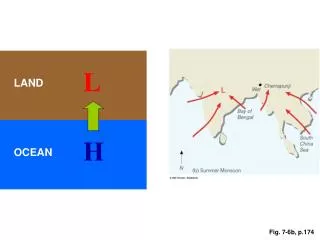
L LAND H OCEAN Fig. 7-6b, p.174
H LAND L OCEAN Fig. 7-6a, p.174
North American Indian/ East Asian African South American
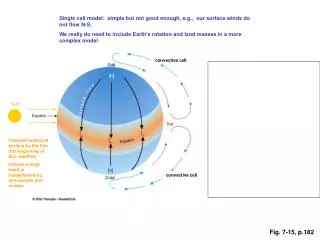
If the Earth was covered entirely in water, the Sun was directly over the Equator, and the Earth did not rotate… L H COOLING H L HEATING L H Equator
CF Fig. 7-16, p.183
PGF PGF PGF COLD WARM NORTH SOUTH
Fluxes between the ocean and the atmosphere Latent heat (moisture) flux Wind stress Sensible heat flux
60°N westerlies CF WARM COLD 30°N CF easterlies Equator