NP-Completeness of Convex Transversals for 2D and 3D Geometric Configurations
280 likes | 425 Vues
This paper explores the complexity of computing convex transversals for geometric configurations, establishing NP-completeness in various cases such as unit-length segments in 2D, disjoint segments in 3D, and disjoint balls in 3D. It discusses foundational problems in computational geometry, including curve reconstruction and motion planning. The authors extend previous work, providing in-depth analysis and introducing challenges, algorithms, and optimizations aimed at maximizing stabbed objects and minimizing stabbings' lengths, ultimately addressing open problems in the field.


NP-Completeness of Convex Transversals for 2D and 3D Geometric Configurations
E N D
Presentation Transcript
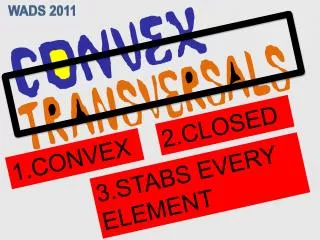
WADS 2011 2.CLOSED 1.CONVEX Shang Yang Stony Brook Univ. 08/17/2011 3.STABS EVERY ELEMENT
2.CLOSED 1.CONVEX Joseph S.B. Mitchell Christian Knauer Esther M.Arkin Claudia Dieckmann ValentinPolishchuk Shang Yang Lena Schlipf 3.STABS EVERYONE
Computing a convex transversal 1987: original problem proposed ArikTamir(NYU CG Day 3/13) 1990: 2d parallel segments solved Goodrich & Snoeyink* * Comp. Vision, Graphics & Image Processing 49(2):152170
Motivation Curve Reconstruction Line Simplification Motion Planning Surface Reconstruction
Our contributions 2d segments, squares, 3d balls proved NP-hard from 3-SAT ? Disjoint segments, pseudodisks Polytime(DP) If vertices are from a given set
NP-Completeness Proof: Stabbing Arbitrary Segments From 3-SAT
Additional Hardness Results • Finding a convex transversal for: • a set of unit-length segments in 2D • a set of pairwise-disjoint segments in 3D • a set of disjoint balls in 3D • a set of disjoint unit balls in 3D Conjectured • is NP-Complete.
Polytime Algorithm: First Step Segment 3-link chain: Bridge chord Segment
Chords Are NEVER INTERSECTED By Any Input Segments
A Bridge Partitions the problem into 2 halves B B p q p q Stab(qp, tr, B)=1 Stab(pq, rt, B)=1 Succeed!! t r t r
DP Current State (pq, rt, qabt) q p a a c b b r t
DP Recursion( abc Case 1) q q p p (c) (c) a a b b r r Stab(pq, rt, qabt) = Stab(pq, rt,qbt) t t
DP Recursion( abc Case 2) q q z z p p a a c c b b r r Stab(pq, rt, qabt) =Stab(pz, rt,zcbt) t t
DP Recursion( abc Case 3) q q z z p p c a c a b b r r Stab(pq, rt, qabt) = Stab(pz, rt,zbt) t t
DP Recursion( abc Case 4) q p a c u Stab(pq, uz, qacz)&Stab(rt, vz, tbcz) z c z b v r t
Base Case(1 & 2) q z p a c b Stab(pq, rt, qabt) = FALSE r t
Base Case(3) q a p b r Stab(pq, rt, qabt) = TRUE t
Review B B p q t r
Symmetry Detection Stabbing with Regular Polygon Polynomial Time Algorithm
Optimization Versions of the Problem • Maximize the number of objects stabbed by the convex transversal (DP) • Minimize the length of the stabber: • TSP with Neighborhoods (TSPN) • Require convexity: Shortest convex stabber • Example: TSPN for lines • Minimize movement of objects to make them have a convex stabber: optimal “Convexification”
Convexification Fast 2-Approximation & PTAS
Convexification: 2-Approx Let Q’ be the convex hull of Q, and let D be the maximum distance from a point, q, in Q to the boundary of Q’. Q’ q D
Summary • Settle the open problem in 2D: • Deciding existence of a convex transversal is NP-complete, in general • If objects S are disjoint, or form set of pseudodisks, then poly-time algorithm to decide, and to max # objects stabbed • 3D: NP-complete, even for disjoint disks Assumes candidate set P of corners of stabber is given. Hard even for terrain stabbers!
3 Open Problems Candidate Points NOT Given? Allowing < k reflex vertices? Fast 2d Unit Disk Case Solver?
Christian Knauer Joseph S.B. Mitchell Esther M.Arkin Claudia Dieckmann Lena Schlipf Thank you! Questions Please! Valentin Polishchuk Shang Yang