Background Sources and Shielding Challenges for the PHENIX Experiment: Insights from 2003
In 2003, we identified beam scraping at the magnet triplets as the primary source of background for the PHENIX experiment. Simulations suggested that better shielding should be closer to the beam pipe and the interaction point, with steel being more effective than concrete. However, various equipment constraints hindered optimal installation. Post-installation observations revealed significant changes in background rates, with the S4-6 components showing increased rates while S1-3 rates remained stable compared to previous years, highlighting the ongoing challenges in radiation management.

Background Sources and Shielding Challenges for the PHENIX Experiment: Insights from 2003
E N D
Presentation Transcript
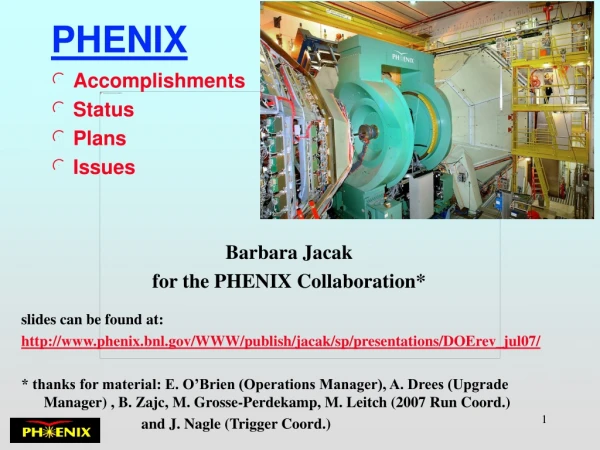
PHENIX background problem Works done in 2003 (Minutes and presentations of the RHIC Experiment Shielding Working Group are kept at : http://www.c-ad.bnl.gov/kinyip/Radiation/RHIC_Shielding.html) Situation now (some observations) … Kin Yip
In ~2003, we have concluded that • Sources of the background for PHENIX (and 2 others) all believed to be due to beam scraping at the magnet triplets (~Q3). • Simulations have showed it’s better for shieldings to be • closer to the beampipe • closer to the IP / MUID • steel better than concrete etc. • But reality (a lot of stuff) has prevented us from installing everything that we’d have hoped for. Eg. there are some equipment near the beam pipe and somehow the shielding can’t be just next to MUID.
scintillators Kin Yip
After the shieldings were installed, through collimations and vernierscans separately for the beams, Angelika has observed that S4-6 don’t seem to be affected by the background and S1-3 don’t seem to be affected by the collisions. • S1-3 rates are ~same as previous years but S4-6 rates have increased significantly this year. • PHENIX MUID have seen 2 components, highest @ gap-0 (closest to the IP) and 2nd highest @ gap-4 (furthest from the IP). • Gap-0 rates go to ~0 when the beams were not colliding.