Precipitation Analysis
This analysis focuses on understanding how to predict precipitate formation when two solutions are mixed by examining the reaction quotient (Q) in comparison to the solubility product constant (Ksp). When Q equals Ksp, a saturated solution occurs with no changes. If Q is greater than Ksp, a precipitate will form until saturation is reached, shifting the equilibrium left. Conversely, if Q is less than Ksp, no precipitate will form, and the solid will dissolve. The text also covers selective precipitation methods for separating metal mixtures, using specific reagents to form precipitates selectively.

Precipitation Analysis
E N D
Presentation Transcript
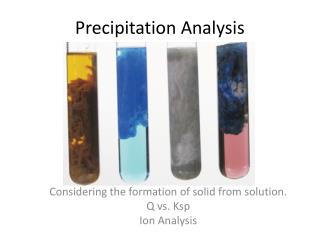
Precipitation Analysis Considering the formation of solid from solution. Q vs. Ksp Ion Analysis
How to predict whether a precipitate will form when two solutions are mixed? • Investigate Qsp vs. Ksp at initial concentrations Q = Ksp “Saturated” solution occurs. No changes. Q > Ksp Precipitates will form until saturated. Equilibrium shifts left. Q < Ksp NO precipitate forms. Solid dissolves. Equilibrium shifts right.
Sample Exercise p. 734 • Predict whether precipitate will form? Q > Ksp PPT will form!
Selective Precipitation • Mixtures of metals in solutions are separated using a technique called selective precipitation. • Using a reagent whose anion forms a precipitate with only one or a few of the metals in the mixture. • Sulfide salts (sulfide ion) is often used!
Qualitative Analysis of Cations • Separating mixtures into five major categories based on solubility. #1. Insoluble Chlorides #2. Insoluble sulfides in Acids. #3. Insoluble sulfides in Bases. #4. Insoluble carbonates. #5. Alkali metals and ammonium ions.