SlideServe
Menu
Préférences
© SlideServe · v2026

Understanding different terms

elan avatar
9 diapositives · 291 Views · Feb 23, 2014

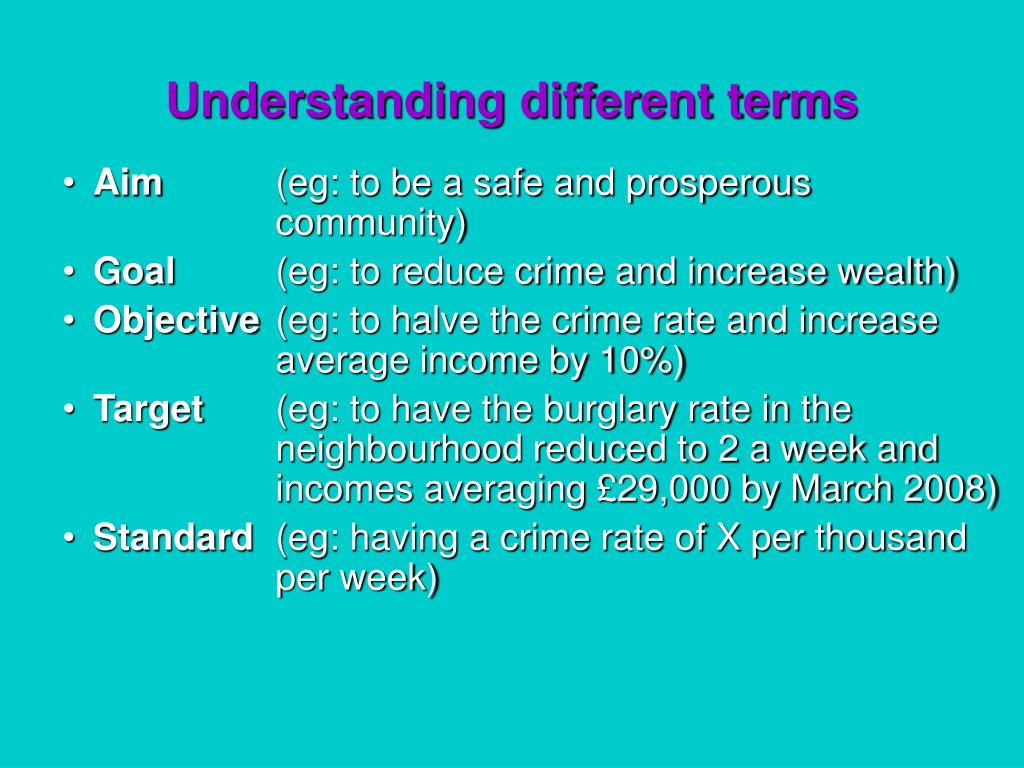
Understanding different terms. Aim (eg: to be a safe and prosperous community) Goal (eg: to reduce crime and increase wealth) Objective (eg: to halve the crime rate and increase average income by 10%)
Understanding different terms - slide 1
01 / 9Understanding different terms
1 / 17

Télécharger la présentation

Understanding different terms
Une image / un lien ci-dessous est fourni (tel quel) pour télécharger la présentation

Politique de téléchargement : le contenu du site vous est fourni TEL QUEL pour votre information et votre usage personnel ; il ne peut être vendu, concédé sous licence ni partagé sur d’autres sites sans l’accord de son auteur.Le contenu vous est fourni TEL QUEL, pour votre information et votre usage personnel uniquement. Téléchargez la présentation en cliquant sur ce lien. Lors du téléchargement, si vous ne parvenez pas à télécharger une présentation, l’éditeur a peut-être supprimé le fichier de son serveur.Pendant le téléchargement, si vous ne parvenez pas à obtenir une présentation, le fichier a peut-être été supprimé par l’éditeur.

F I N

Plus de contenu associé

Transcription de la présentation
  1. Understanding different terms • Aim (eg: to be a safe and prosperous community) • Goal (eg: to reduce crime and increase wealth) • Objective (eg: to halve the crime rate and increase average income by 10%) • Target (eg: to have the burglary rate in the neighbourhood reduced to 2 a week and incomes averaging £29,000 by March 2008) • Standard (eg: having a crime rate of X per thousand per week)

  2. What are Targets for? Targets exist to: • provide direction / let people know what is expected of them in contributing to the organisation’s goals • provide a formal structure for giving and receiving feedback on performance • help assess and improve an organisation, team or individual’s performance • help identify learning and development needs • provide a challenge • increase motivation and satisfaction • deliver priorities

  3. S.M.A.R.T.E.R. Targets Specific (positively stated) Measurable (quality, quantity, time, cost) Agreed (understood and owned) Realistic (meaningful and achievable) Timebound (therefore trackable) Exciting (stretching and motivational) Rewarding (recognised)

  4. Setting S.M.A.R.T. Targets • Focus on outcomes - what will be achieved, to what standard, in what quantity, with what resources, by whom, by when • Use precise and active verbs e.g. to identify, measure, produce, write, reduce, meet etc. • Be precise, do not use vague or woolly language • Use plain English and avoid jargon • Regularly monitor progress against the target and revise it if necessary

  5. To increase To write To produce To deliver To complete To co-ordinate To have organised To select To create To manage To measure To identify To reduce To develop To respond To provide To facilitate To contribute To carry out Specificexamples of active verbs

  6. Measurable • Quality • Quantity • Time • Cost • Resources

  7. Agreed • You can get commitment and ownership from agreeing rather than imposing targets • Ensure proper consultation with the community and find the best ways for their views to be heard • The needs and interests of the organisation, team and individual all need to be considered

  8. Realistic • Targets should neither be too easy nor impossible. • They should stretch the organisation, team or individual to achieve the best results possible

  9. Timebound • Targets should have an end date so that you can monitor, review and evaluate them. • For a one year project, monitoring would normally be at least quarterly and review 6-monthly. • All involved should know what the timeframe is for the project and their individual targets at those dates.