Download
1 / 20
200 likes | 329 Vues
Brenau University is committed to the success of nearly 400 online degree students and an additional 500 students in online classes. The university supports 250 full-time and adjunct faculty members with structured administration and training initiatives. Key roles include Online Student Coordinator and Online Faculty Coordinator, ensuring effective communication through the Learning Management System (LMS). Faculty receive ongoing training with the Online Facilitator Certification Course and “Blackboard Basics” to enhance their online teaching techniques, fostering an engaged learning environment for all.

E N D
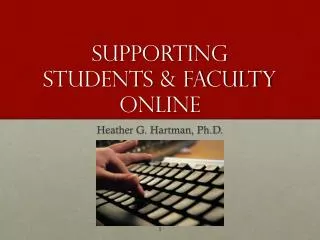
SupportingStudents & Faculty Online Heather G. Hartman, Ph.D.
Online Structure • Brenau University currently supports: • Nearly 400 students in online degree programs • Nearly 500 additional students taking online classes • Nearly 250 full-time and adjunct faculty at any one time • Online Student Coordinator • Primary contact for online students • Primary contact for students using Learning Management System • Online Faculty Coordinator • Primary contact for online faculty • Primary contact for faculty using Learning Management System
Admin structure • Various models house online in either the academic or administrative units, or bothAt Brenau University: • Faculty training and support is considered academic, oversight by the VP for Online Studies and the Vice President for Academic Services (VPAS) • Student and enrollment issues are administration, oversight by the non-residential campus VP and the Executive Vice President (EVP).
systems • Support for faculty • Training required for all, regardless of experience • Standard online course format • Participation tracking • Prompts • Support for students • Orientation course site with modular exercises • Attendance requirement • Phone calls to check-in • Administrative withdrawal process • Prompts
Faculty training • Administration support is vital • Mandatory successful completion prior to class start • Coordination with department chairs and deans regarding scheduling new faculty • Ongoing professional development – Online Summit
Faculty classes • “Blackboard Basics” Course (tools) • Self-paced tutorial with 20 modules • Quizzes to evaluate knowledge • Development class site (sandbox) to demonstrate mastery • Online Facilitator Certification Course (methodology) • Use all tools • Collaboration focus • Content focuses on online facilitation and andragogy
Blackboard basics 20 modules are offered in the Bb Basics course: 1: Beginning – Online facilitation and Learning Management System (LMS) 2: Export/Import – Class site management 3: Control Panel – General map of where things are 4: Course Design – Weekly layout with agendas; Wednesday start 5: Announcements – Importance, posting, management 6: Introductions – Greeting class, icebreaker activities, tools available 7: Syllabus – Model syllabus, required language, differences for online 8: Groups – Why use groups? Setting up, management, tools 9: Folders/Items – Organizing the site for students, advantages 10: Communication – Tools available in the LMS
Blackboard basics Bb Basics modules continued: 11: Discussion – How to use the tool, writing critical thinking questions, management 12: Journals/Blogs– Why? How to use the tool, configuring, management 13: Wikis– Why? How to use the tool, configuring, management 14: Podcasts– Why? How to use the tool, using Audacity 15: External Links – How to post links, how links can be useful 16: Tests – Types of test questions, posting tests, grading tests 17: Grade Center – Must use, management, updating 18: Assignments – Why? How to use the tool, grading 19: Performance – Performance dashboard (last login, posts to DB, etc.) 20: Bb Scholar – Why? How to use the tool
Development site • Each faculty member is provided his or her own site • Various exercises are required • Post an announcement • Post a banner • Set up the main course menu • Create and post a discussion question, etc. • Sites are “graded” by Online Faculty Coordinator • Professors must satisfactorily complete each assignment. • Gives them a “sandbox” if they want to play/test/experiment.
Standard format All online class sites have same main course menu: • Announcements (standard course entry point) • Discussion (one link to all forums) • Syllabus (required to post syllabus here; also good for class schedule) • Grades (link for student grades, required) • Weeks 1-7 (agenda, handouts, reading assignments, quizzes, etc.) • Resources (anything that might be used throughout course) • Faculty (contact info, credentials, something personable) • Groups (online if used) • Extra tools (at the professor’s discretion, Blog, Wiki, etc.)
Online facilitator The Online Facilitator Certification (OFC) course: • 4 Weeks, Online format • Administrative withdrawal after first week • Highly interactive, typical online class. Faculty gain: • Empathy for students with technology issues • Modeling good and poor facilitation, differing styles • Healthy gauge of student/faculty workload feasible • Value of participation, timely feedback, grading
Online summit • For continued professional development, Brenau has hosted an Online Summit for 6 years. • At main campus, all faculty teaching online invited. • Discuss “what we do” – teaching • Hands-on workshops and technology demos • Best practice presentations from faculty members • Social time • Door prizes and award
Instructor stats • Instructors’ course statistics are retrieved • Faculty not meeting attendance requirement of students are referred to their academic dept chairs • While they are not withdrawn, Online Studies can and has recommended that a faculty member not teach online due to poor performance
Prompting faculty • Faculty • 15-day email • Checklist for course site readiness • Audits of course sites • Administrative withdrawal: students in jeopardy
Student orientation • A class site similar to the instructor’s Bb Basics course should be constructed for students. • Information about how online classes work should be available on the website, intranet, and within the Basics site for students. • Advisors should conduct a review of technology systems for students. Make sure they have access.
attendance • Attendance and participation are different • Students must “attend” online classes 5 of 7 days • Keeps them engaged with the material • Keeps them caught up on discussion • Assignments and questions are posted throughout the week. • Advisory postings by professor are not missed. • Students not attending during Week 1, withdrawn • After Week 1, grades will likely suffer due to failure to attend.
Phone calls • Phone each student during the first week • Are you settled in your class? • Did you purchase your textbook? • Do you have any questions? • Small staff? Use work study students to call • Leave messages or refer questions to staff. • Students appreciate personal touch.
Administrative w/d • First week of class is critical • Course statistics are used to identify absentees • Notify instructors of students in jeopardy • Instructors have the final call; most familiar with participation and progress • Registrar & Financial Aid offices notified to ensure official drop and adjustment of aid • Letters and phone calls to students are made • Every session, professor readmit students (tardy)
Prompting students • Students • Time to register • Classes start in 2 weeks • Phone calls checking in • Course evaluations are available, required for online grade viewing