Understanding Financial Institutions and Loans: A Comprehensive Overview
220 likes | 348 Vues
This lesson explores financial institutions, including banks, credit unions, and their various services. Students learn about the importance of credit, types of loans, and the implications of collateral. The session will highlight the Federal Deposit Insurance Corporation (FDIC) and non-deposit accounts, discussing the risks and benefits involved. Activities will include vocabulary enhancement, critical thinking on credit importance, and the comparison of home loans. Prepare to engage in discussions and hands-on activities that deepen your understanding of personal finance.


Understanding Financial Institutions and Loans: A Comprehensive Overview
E N D
Presentation Transcript
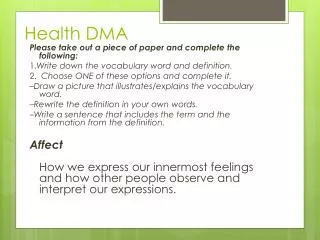
Health DMA Please take out a piece of paper and complete the following: 1.Write down the vocabulary word and definition. 2. Choose ONE of these options and complete it. –Draw a picture that illustrates/explains the vocabulary word. –Rewrite the definition in your own words. –Write a sentence that includes the term and the information from the definition. AffectHow we express our innermost feelings and how other people observe and interpret our expressions.
Today’s Agenda • DMA • Banks & finance • Pre-test • Types of banks • Types of accounts • Types of loans
Pre-Test Everyone needs a handout Write all your answers on your own paper.
Insured Financial Institutions • Banks/Thrifts: • Federal & state laws • Make loans, pay checks, accept deposits, & other services • Credit Unions: • Same as banks (services) • Non-profit financial institutions • Require a membership
Check Your Balances…. • Always know how much is in your account!
Fees • Monthly maintenance fees • Penalty fees • Overdraft fees
FDIC • Deposit $ into a bank/thrift/credit union • up to $250,000.00 • FDIC/NCUA insures it
Interest % of your balance that the bank pays you for keeping your $ at that bank $77
If the FDIC insures accounts… how do people lose so much $ in the stock market? Discuss with a neighbor…
Non-Deposit Accounts • Includes stocks, bonds, & mutual funds • Not FDIC-insured • You may risk losing your investment.
Name That Service • Everyone needs a handout • Put the name of the service next to its description • The signs around the room have the names of the services • Move around quietly to find the answers
Why is credit important? Discuss with a neighbor…
Why Is Credit Important? • It’s convenient • Emergencies • Pay for purchases over time • Can affect your ability to obtain employment, housing, & insurance
What is Collateral? • Security/assest you pledge to the lender • If you do not repay the loan • the lender is allowed to take/keep the collateral.
Home Loans • Home Purchase Loans • Primary loan for purchasing a home • Home Refinance Loans • Loan that replaces primary home loan • Home Equity Loans • Second mortgage/loan secured by the borrower’s home
Home Equity A lender may allow you to borrow up to a certain percentage of your home’s value(usually 80%)
The Four Cs • Capacity: Your ability to meet payments • Capital: Value of your assets and net worth • Character: How you paid your bills or debts in the past • Collateral: Property/assets used to secure the loan
Predatory Lending Practices • Predatory loans: • Are usually more expensive than other loans • Have repayment terms many consumers cannot meet • Exploit borrowers
What are pay-day loans?List some companies that offer them… Discuss with a neighbor….
Pay-Day Loan Services • Short-term, costly loans If you “roll over” or “renew” your loan, the lender will charge an additional fee: $230 + $30 additional fee = $260!
When You Need $ Fast • Borrow from yourself first • put money into an emergency savings account • Comparison shop for loans • Look at ALL fees & risks • Check out emergency cash options with your bank