Download
1 / 39
390 likes | 495 Vues
Chapter 8 of "The Social Life of Information" by William H. Bowers delves into the transformative pressures facing higher education today. As student demographics shift and the competition among institutions intensifies, schools are increasingly adopting business-like models. This chapter explores the challenges of misrepresentation in academia, the evolution of learning models, and the significance of peer support. Bowers examines innovative solutions like disaggregated education and highlights the persistent resistance to change within the educational landscape, stressing the importance of redefining the purpose of degrees.

E N D
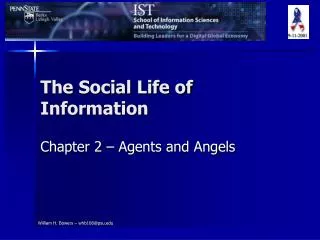
The Social Life of Information Chapter 8 – Re-Education William H. Bowers – whb108@psu.edu
Topics • Pressures • Solutions • Resistance • Competing by Degrees • Degrees of Representation William H. Bowers – whb108@psu.edu
Topics • Misrepresentation • Learning not Lading • Peer Support • Degrees of Distance • A Distant Prospect William H. Bowers – whb108@psu.edu
Topics • A Sense of Place • Recomputing Distance • Reorganizing • Unpicking the Threads William H. Bowers – whb108@psu.edu
Pressures • Student population is changing • Previously typical student is becoming rare • Students are generally becoming older • Working adults • Want more relevant education, topics William H. Bowers – whb108@psu.edu
Pressures • Competition • Schools becoming more business like • Considering • Markets • Products • Clients • Customers • Mega-Universities William H. Bowers – whb108@psu.edu
Pressures • University of Phoenix • Accredited in 1978 • Grown to • 62,000 students • 77 campus centers • 450,000 alumni • For profit institution • Generally cheaper than traditional schools William H. Bowers – whb108@psu.edu
Pressures • Corporate research centers (Xerox PARC, Microsoft) competing for funds, projects • New technologies changing academia William H. Bowers – whb108@psu.edu
Solutions • 6-D focus on disaggregation • Redefinition of education, libraries, etc. • ‘Endism’ • PSU’s World Campus • California’s Virtual University William H. Bowers – whb108@psu.edu
Resistance • Overcoming distance limitations • Medieval traveling scholars • Correspondence courses • Radio, TV, video courses • Early ’70s – PLATO U of Illinois • Net, ftp, email • Early ’80s – USC online courses William H. Bowers – whb108@psu.edu
Resistance • California Virtual University • Not a replacement for bricks and mortar • Not degree or certificate granting • Offers information about CA based distance learning • Essentially an online catalog William H. Bowers – whb108@psu.edu
Resistance • IBM Indiana University Library ad • Fictional, not reflection of fact • May not happen in granddaughter’s lifetime • Online Ph.D. is rare in US • Mostly in education • Not highly regarded or accepted William H. Bowers – whb108@psu.edu
Competing by Degrees • US system of higher education is self-organized • 11,000 institutions, 4,000 accredited • About 14.6 million students • Is the degree their objective? • Is credentialing the objective? William H. Bowers – whb108@psu.edu
Competing by Degrees • Granting degrees is not the only thing universities do • Credentialing is not simple • Degrees are not equal William H. Bowers – whb108@psu.edu
Degrees of Representation • “Marketplace of ideas” • “Knowledge markets” • “Knowledge exchanges” • Is knowledge becoming a commodity? • Can’t it just be bought and sold? William H. Bowers – whb108@psu.edu
Degrees of Representation • Knowledge doesn’t circulate easily • It is hard to detach (Chapter 5) • Difficult for buyers to assess • If you can evaluate it, you don’t need it • If you need it, you can’t evaluate it William H. Bowers – whb108@psu.edu
Degrees of Representation • You hire experts because you lack their knowledge • How do you evaluate them? • Education is a similar dilemma • We rely on independent reviews • How do you determine Professor’s worth in teaching a course? William H. Bowers – whb108@psu.edu
Misrepresentation • Not deliberate degree mills • Hidden details of degrees • Socially, but not business valued activities • Analogous to legislative “omnibus package” which hides details • Behind scenes work is hidden William H. Bowers – whb108@psu.edu
Misrepresentation • Relies on ‘institutional trust’ • Avoids micromanagement of degree • Allows for a certain amount of slack • Permits elective courses & serendipity William H. Bowers – whb108@psu.edu
Learning not Lading • Degrees sometimes viewed as ‘intellectual bill of lading’ • ‘Teaching is a delivery service’ • Schools are ‘loading sites’ • Knowledge delivery rather than ‘learning to be’ William H. Bowers – whb108@psu.edu
Learning not Lading • Teaching involves engaging in communities of practice • Lower level and some technical courses are prime targets of delivery • Progress from learning about to learning to be William H. Bowers – whb108@psu.edu
Peer Support • Apprenticeship puts learners in contact with the leaders in their fields • Peers can be equally valuable resources • Early attempt at distance learning • Stanford engineering class taped and delivered to HP William H. Bowers – whb108@psu.edu
Peer Support • Early attempt at distance learning • Engineers would watch as a group • Regularly stopped tape and discuss • Engineers outperformed classroom students • Why? • Individual (distance) learning loses this benefit William H. Bowers – whb108@psu.edu
Degrees of Distance • Access to communities is different than access to information • Worldwide demand for education is growing • Geographic distance can be minimized by IT • Social distance is not overcome by IT William H. Bowers – whb108@psu.edu
A Distant Prospect • IT can minimize time and space limitations of traditional education • Best as extension, not replacement • Difficult to form suitably dense communities virtually • Better at maintaining communities than creating them William H. Bowers – whb108@psu.edu
A Distant Prospect • Providing laptops to all students may exacerbate social distance • Conventional campuses not likely to disappear • Online activities complement offline • IT may keep students from traditional campuses William H. Bowers – whb108@psu.edu
A Sense of Place • For-profit schools centralize course design • No or limited local input • Most learning is local • Knowledge ecologies are local • Centralization pulls against this William H. Bowers – whb108@psu.edu
Recomputing Distance • 19th century University of London allowed for external degrees • Localized specialization • Centralized support and resources William H. Bowers – whb108@psu.edu
Reorganizing • Pressure to change higher education • Change may be instructive elsewhere • IBM ad shows idealistic view but ignores social context • Optimal reorganization will be blend that uses IT for support • Balance centralized and local William H. Bowers – whb108@psu.edu
Unpicking the Threads • What seemed ridiculous ten years ago may be commonplace today • Learners require three things from higher education • Access to communities of learning and knowledge • Resources to work within distant and local communities • Widely accepted representations for learning and work William H. Bowers – whb108@psu.edu
Unpicking the Threads • Conventional universities have met these through students, faculty, research, facilities and the institution • New technologies may loosen the configuration • New forms of higher education are tending to ignore at least one factor William H. Bowers – whb108@psu.edu
Unpicking the Threads • Students • Changing demands on university in response to demands on them • Need to address short-term, long-term and lifelong needs • Require good credentials William H. Bowers – whb108@psu.edu
Unpicking the Threads • Degree-Granting Bodies • Distributed education system • Must provide adequate credentials • Requires public trust • Allows for flexible matrices • Require degrees balanced between focus and breadth William H. Bowers – whb108@psu.edu
Unpicking the Threads • Faculty • Might have teaching methods sanctioned • Sanction could allow students to work with different faculty (at different Universities) for credit towards degree • Research • Important for students to have access to practitioners in their field William H. Bowers – whb108@psu.edu
Unpicking the Threads • Research • Important to have faculty keep current • Research depends on student labor • May be performed privately • Might be too expensive for private support William H. Bowers – whb108@psu.edu
Unpicking the Threads • Facilities • Could be provided by individual faculty • May be more cost effective for groups • Good facilities attract good faculty and students • Looking beyond the campus • Reconfiguration expands student choices William H. Bowers – whb108@psu.edu
Unpicking the Threads • Looking beyond the campus • Students choose by different factors • Campus location • Specific faculty members • Faculty in multiple regions • Allows access to working communities • Requires information organization, search and retrieval William H. Bowers – whb108@psu.edu
Devolving Implications • This is a catalyst, not a road map • Predictions may not be accurate • Change will most likely be required • Change will be evolutionary, not revolutionary William H. Bowers – whb108@psu.edu
Questions & Discussion William H. Bowers – whb108@psu.edu