Download
1 / 28
490 likes | 1.19k Vues
This presentation explores the Livelihoods Framework, emphasizing the connections between forestry and livelihoods. It discusses how diverse income sources contribute to risk mitigation, enhance food security, and improve living standards. The importance of understanding vulnerability, policies, and institutions in shaping livelihoods is highlighted. Key insights into data analysis, including wealth differentiation and income portfolios, showcase the benefits of diversification in forestry management. The aim is to identify barriers and empower communities to create sustainable pathways out of poverty through informed practices and policies.

E N D
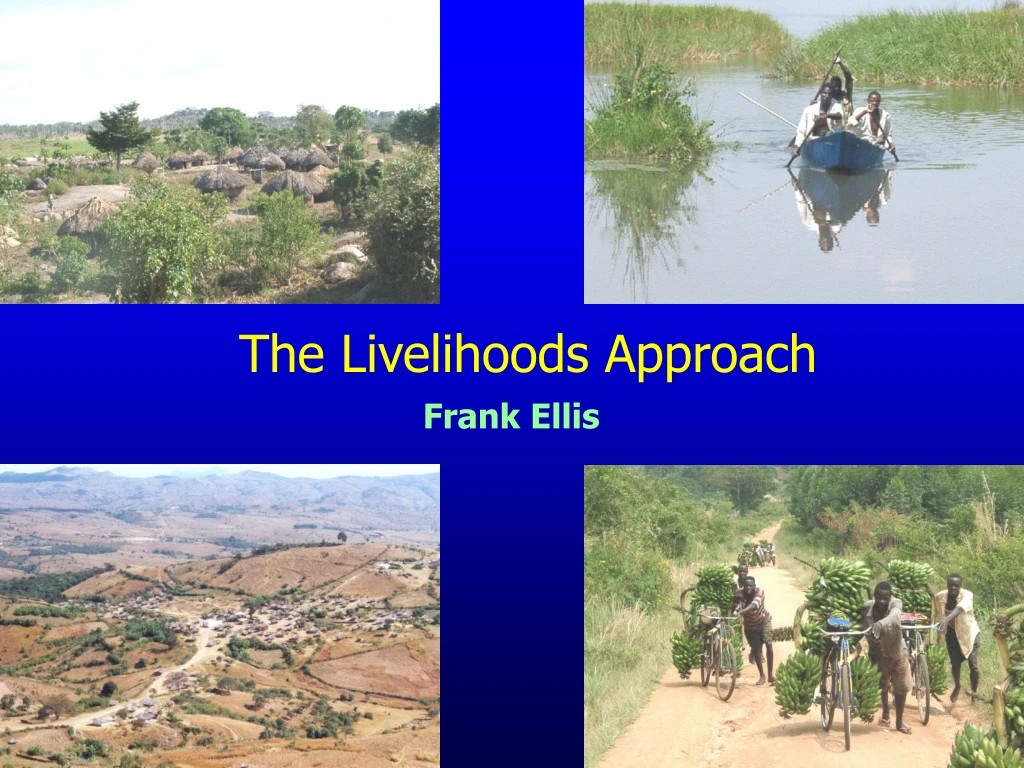
The Livelihoods Approach Frank Ellis
Coverage of This Presentation • the livelihoods framework • forestry connections to the framework • preliminary ideas about data analysis
Activities Generate Incomes A Typical Income Portfolio
Points About Diverse Income Sources • risk mitigation – reduces vulnerability • smooths seasonality – labour & incomes • generates cash income, increasing options • potential to enable accumulation – virtuous livelihood spiral • forest products – part of income diversity
Two Main Categories of Outcome • outcomes for living standards and well-being, incl.: • attainment food security • poor or non-poor (w.r.t. poverty line) • outcome for quality and sustainability of natural resources
What is Vulnerability? • vulnerability typically refers to vulnerability to hunger – the gap between the ability to access food and the minimum consumption needs of the family • vulnerability is a relationship between the risk of an adverse event, and the ability to deal with that event if it occurs • so high risk of adverse events, and inability to cope if a shock occurs, denotes high vulnerability
Unpacking the Policy and Institutions Box • government, governance, decentralisation, taxation • authority, power, participation, ability to influence decisions • social relations: kinship, gender, ethnicity, religion • rights: property rights, forest access rights, wide variety of human rights • (some of these map to social capital)
Policies and Institutions can Increase Risk and Vulnerability
Removal of Blockages The livelihoods approach encourages questions to be asked about blockages to building improving livelihoods, therefore directing attention to the removal of such blockages in order to give people greater scope to construct their own routes out of poverty.
Removal of Blockages (Quote) "to identify what the poor have rather than what they do not have" and "[to] strengthen people's own inventive solutions rather than substitute for, block, or undermine them" Moser (1998: p.1)
Forests in the Livelihoods Framework Framework helps to map the way forest products fit into livelihoods: • ASSETS - forests a shared or joint asset • ACTIVITIES - extraction forest products • OUTCOMES - higher income/consumption; changing forest quality • VULNERABILITY - critical coping role • INSTITUTIONS – forest management
Preliminary Thoughts on Data Analysis • differences in wealth & income critical • aggregate household net income • derive per capita HH income (AEU) • income terciles or quartiles for descriptive stats • wealth ranking groups, an alternative
Rising Non-Farm Share, Rising Income310 HHs Tanzania, Per Capita Income Quartiles
Forestry Management Institutions • often a gap between the rhetoric & reality of such institutions • ‘elite capture’ common in CBNRM institutions • need to derive a historical picture of how access has evolved over time for different social groups • combining qualitative & quantitative data • success or failure at ensuring sustainability of forest product extraction