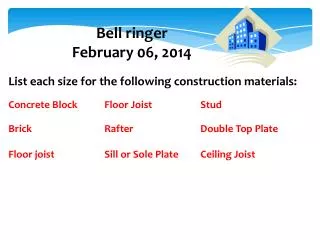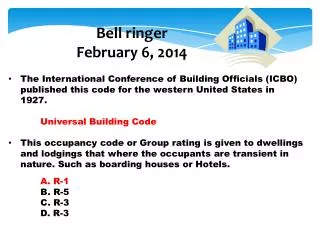
Bell ringer February 6 , 2014
30 likes | 158 Vues
This resource focuses on the essential aspects of building codes, specifically the Universal Building Code introduced by the International Conference of Building Officials (ICBO) in 1927 for the western United States. It examines occupancy classifications such as R-1 for transient dwellings and highlights the design process, including different house styles, site analysis, and the impact of building codes on design. Students will learn to create dimensioned floor plans, understand architectural blueprints, and appreciate the significance of following building codes in construction.


Bell ringer February 6 , 2014
E N D
Presentation Transcript
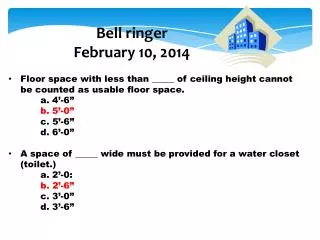
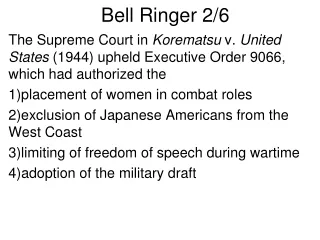
Bell ringer February 6, 2014 • The International Conference of Building Officials (ICBO) published this code for the western United States in 1927. • Universal Building Code • This occupancy code or Group rating is given to dwellings and lodgings that where the occupants are transient in nature. Such as boarding houses or Hotels. • A. R-1 • B. R-5 • C. R-3 • D. R-3
Unit 3- Building Codes ACT-ADDI-1. Students will identify components related to the design process. a. Demonstrate an understanding of different house styles. b. Describe the steps in the design process. c. Describe the elements and principles of design. d. Identify the proper use of site analysis. e. Explain how building codes and ordinances affect design. f. Identify the drawings required for residential construction. g. Read architectural blueprints. h. Measure using an architect’s scale. ACT-ADDI-2. Students will prepare residential floor plans. a. Draw dimensioned floor plans using appropriate symbols. b. Apply appropriate dimensioning rules for frame and masonry construction.
Unit 3- Building Codes Essential Questions 1. What is BOCA, SBCCI, ICBO? 2. What is the difference in a building code and a building ordinance? 3. Why do building codes exist? 4. What happens if the building code is not followed?