The Scientific Method
Explore the fundamentals of the scientific method, from observation to conclusion, and its application in everyday scenarios. Learn about hypothesis testing, experimental design, reproducibility, assumptions, and the role of statistics in scientific inquiry.

The Scientific Method
E N D
Presentation Transcript
The Scientific Method An overview
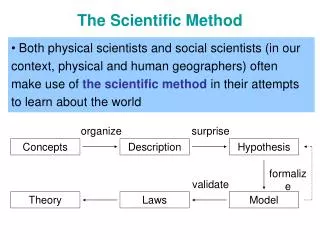
What is Science? • “Science” derived from Latin ‘to know’ • Way of asking and answering questions While studying the natural world around you. • Seeking answers to questions about natural phenomena (we are therefore limited to what kinds of questions we ask) • Scientific thinking reduces emotional reactions
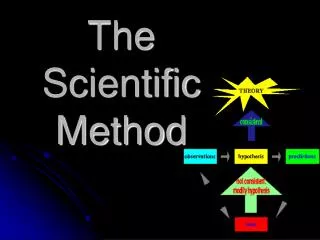
Scientific Design • Scientific knowledge begins with an observation and a proposed explanation. • Introduction – Background information about your topic • Hypothesis- an Explanation • A hypothesis is testable and falsifiable • In science hypotheses are tested by using them to make predictionsabout how a particular system will behave
Method: The process of exactly how you preformed the experiment described in exhaustive detail. Results: Detailed charts, data tables and graphs that display your results Conclusion: Detail analysis of your results, explain potential errors
Does it work? • Scientific Method is a tool. • Does this tool work? • Life expectancy • Mortality rates • Are there better tools?
Scientific Method in Action • We use the scientific method in everyday life • Example: You got in your car to drive up here and turned the key but the car wouldn’t start (observation)
Scientific Method in Action Example: You got in your car to drive up here and turned the key but the car wouldn’t start (observation) Hypothesis: There is something wrong with the car
Scientific Method in Action Example: You got in your car to drive up here and turned the key but the car wouldn’t start (observation) Hypothesis: There is something wrong with the car Hypothesis: battery dead, ignition problem, out of gas
Scientific Method in Action • Test predictions (Method): turn on headlights, check spark plug wires, dip stick in gas tank
Scientific Method in Action • Test predictions: turn on headlights, check spark plug wires, dip stick in gas tank • Analyze results: headlights work, strong ignition spark, no gas on dip stick-gas gauge reads half full
Scientific Method in Action • Test predictions: turn on headlights, check spark plug wires, dip stick in gas tank • Analyze results: headlights work, strong ignition spark, no gas on dip stick-gas gauge reads half full • Conclusion: gauge inaccurate, out of gas
Example • Hyp: King’s collar repels fleas • Pred: dogs wearing King’s collar will have fewer fleas than those without collar IV: King’s collar DV: presence of fleas CV’s: anything that might effect the number of fleas on the dogs Can we think of some???
Experimental Design • Obtain 500 dogs of various breeds from local shelters. Have vet weed out the 200 dogs with the most fleas. Randomly assign individuals to 2 groups. • Board the dogs in identical environments and treat them the same except that one group gets to wear the King collar and the other group does not • After 2 wks. The dogs are examined by a vet for fleas.
Results: the dogs wearing the King collars were virtually free of fleas after the 2 wk period compared to the dogs without the collars which had about the same number of fleas as when the experiment began
Important terms: Instrument: the object or survey that helps you collect data to be analzed.
Important terms: Sample: a chosen population to represent a scientific study. - Example: LHS students, Men, Asians - Use common sense when choosing a sample -Random sampling- Each member of the population has an equal chance of being selected. (best sample) Experimental group: group(s) subjected to the independent variable Control group: group not subjected to the independent variable, used as measuring stick
Reproducibility • reproducibility: producing the same result consistently to verify result.It is therefore important to describe your experimental design in enough detail for others to perform the same experiment. • A successful Experiment is repeatable. • By anyone. • Examples: • Cold Fusion (1989) • Ecstasy (Science, 2003)
Assumptions: factors thought to be true for the investigation but have not been verified or controlled • Commonly accepted information • Thought to be held constant but not controlled • Factors beyond the investigators control because of technical or time considerations • Incorrect assumptions invalidate an experiment!
Statistics: • Statistics – using mathematics to organize, summarize, and interpret numerical data • Mean: arithmetic average of scores • Variability = how much scores vary from each other and from the mean
“There are three kinds of lies: lies, damned lies, and statistics” - Benjamin Disraeli