Matter
Matter is anything that occupies space and has mass, with properties classified into physical and chemical. Physical properties, such as mass and color, can be observed without altering the substance, while chemical properties, like rusting and burning, require a transformation. Properties are further divided into intrinsic (independent of quantity) and extrinsic (dependent on quantity). Density, calculated as mass divided by volume, is crucial in understanding matter's behavior. This guide illustrates differences between physical and chemical changes with examples to enhance comprehension.

Matter
E N D
Presentation Transcript
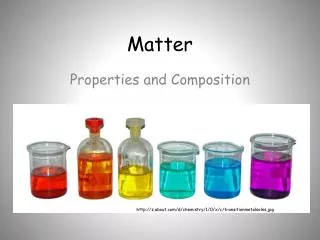
Matter Properties and Composition http://z.about.com/d/chemistry/1/0/x/c/transitionmetalsolns.jpg
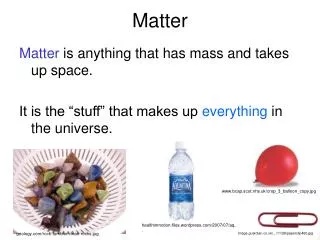
So What is Matter? • Anything that occupies space and has mass What isn’t mass? • Energy • Ideas • Sound • And…
Properties • Physical Property - any property that can be observed without transforming the substance into another substance mass, color, freezing point • Chemical Property - any property that cannot be studied without transforming the substance into a different substance iron rusts, paper burns
Properties • Intrinsic – does not depend on the amount of material you have color, solubility, viscosity, malleability, boiling point, density • Extrinsic – depends on the amount of matter mass, volume, length
Density • Property derived from two measurements, mass and volume • Density = Mass/Volume • Will have a unit that contains both mass and volume such as g/cm3, lb/gal, kg/L • Does not depend on the size of the sample
Density • What is the density of a sample of metal that has a mass of 34.58 g and when placed in 15.0 mL of water causes the level to rise to 22.4 mL?
Changes • Physical Change - change that does not transform the substance into another substance melting, subliming, dissolving
Changes • What were the physical changes that you encountered in activities on Day 2?
Changes • Chemical Change -change that transforms the substance into another substance burning, oxidation of metal • http://jchemed.chem.wisc.edu/JCESoft/CCA/pirelli/pages/cca1NaIHgCl2.html
Chemical Change From Silberberg, Principles of Chemistry, 2007 CHM 1010 PGCC Barbara A. Gage
PROBLEM: Decide whether each of the following process is primarily a physical or a chemical change, and explain briefly: Distinguishing Between Physical and Chemical Change (a) Frost forms as the temperature drops on a humid winter night. (b) A cornstalk grows from a seed that is watered and fertilized. (c) Dynamite explodes to form a mixture of gases. (d) Perspiration evaporates when you relax after jogging. (e) A silver fork tarnishes slowly in air. SOLUTION: (a) physical change (b) chemical change (c) chemical change (d) physical change (e) chemical change