Download
1 / 19
190 likes | 294 Vues
Explore the comprehensive limnological assessment of Lucas Pond through sediment analysis, macro invertebrate assessment, and identification of species present. Results and implications are discussed, highlighting the impact on water quality and ecosystem longevity.

E N D
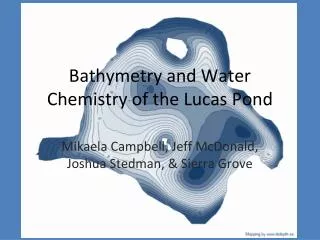
A Limnological Assessment: The Lucas Pond Christian Brown Dylan Gollen Taylor Lasley John Novak
Overview • Objectives • Methods and Materials • Results • Discussion • Implications
Team Objectives Sediment Analysis Macro Invertebrate Assessment Identify species present Enumerate densities • Water content • Organic matter
Methods and Materials Field Equipment Lab Equipment Digital scale and weigh boats Oven Metric ruler • KB Core sampler • Ekman grab sampler • Pencils, notebook, tape • Storage containers
Methods and Materials Sampling Design • KB core and Ekman samples were taken in a balanced manner that encompassed the greatest area of the pond • Seven samples total for each sampling method • Two samples from east and west sites • Three replicates from middle site
Methods and Materials Analyzing KB Core Samples Water Content • measured total core depth (cm) • removed 1cm sections • recorded wet weights of each section • placed samples in oven, then recorded dry weights Percent Water Content = Wet weight-dry weight/wet weight
Methods and Materials Organic Matter • Placed dried samples into oven for burning • Recorded ash weight Percent organic matter = dry weight – burn weight/ dry weight
Methods and Materials Benthic macro invertebrates • collected with Ekman grab sampler • Same sample sites • Samples filtered through wash bucket (remove sediment) • samples were stored and preserved in ethanol solution • species identified and enumerated using dissecting microscopes • densities were converted from Ekman volume (225cm2) to number per square meter
Discussion Sediment Accumulation • Pond size • Steep catchment • Surrounded by granitic Gneiss rock • Allocthonous inputs from vegetation and rock
Discussion Benthic Macro-Invertebrates • Relatively high abundance • Chaoborus, Chironimids, and Oligochetes contribute to bioturbation(Ademek et al. 2009) • Mechanical mixing of sediment through construction of feeding tubes and burrows • Affects transport of nutrients, particularly P and N • Increases oxygen penetration into sediment which enhances mineralization process by which nutrients are released into the overlying water • Inhibition of phytoplankton and benthic macrophyte growth • Chironomid larvae can increase nutrient enrichment which can eventually lead to eutrophication
Implications • When considering the benthic aspects of the Lucas pond the longevity is dependent upon: • High rates of total sediment and organic matter accumulation • Unchecked population of benthic macro invertebrates could diminish pond water quality through process of bioturbation
Literature cited • Ademek, Z. Marsalek, B. 2013. Bioturbation of sediments by macroinvertebrates and fish and its implication for pond ecosystems: a review. Aquaculture Int. 21:1-17 • Brainard, A. S. Fairchild, G.W. 2012. Sediment characteristics and accumulation rates in constructed ponds. Journal of Soil and Water conservation. Vol. 67, no. 5. pp. 425-432