
SlideServe
Menu
Préférences
© SlideServe · v2026

Caring for Country, Caring for Sea, Caring for Future Generations

ellis avatar
8 diapositives · 313 Views · Oct 09, 2014

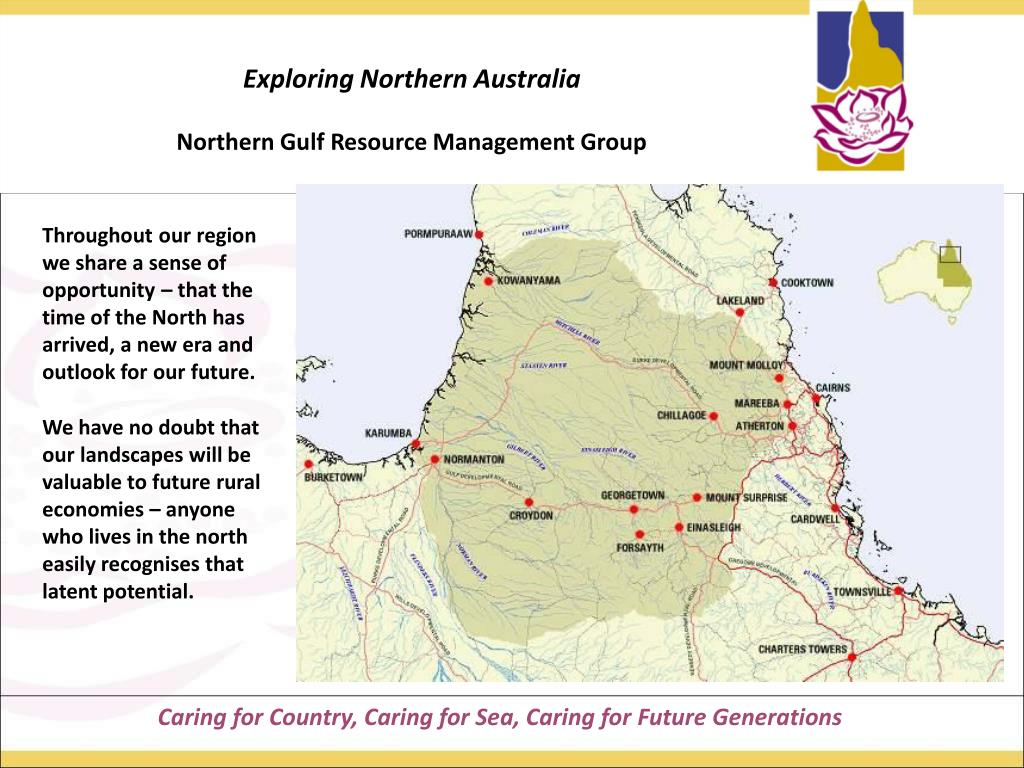
Exploring Northern Australia Northern Gulf Resource Management Group. Throughout our region we share a sense of opportunity – that the time of the North has arrived, a new era and outlook for our future.
Caring for Country, Caring for Sea, Caring for Future Generations - slide 1
01 / 8Caring for Country, Caring for Sea, Caring for Future Generations
1 / 17

Télécharger la présentation

Caring for Country, Caring for Sea, Caring for Future Generations
Une image / un lien ci-dessous est fourni (tel quel) pour télécharger la présentation

Politique de téléchargement : le contenu du site vous est fourni TEL QUEL pour votre information et votre usage personnel ; il ne peut être vendu, concédé sous licence ni partagé sur d’autres sites sans l’accord de son auteur.Le contenu vous est fourni TEL QUEL, pour votre information et votre usage personnel uniquement. Téléchargez la présentation en cliquant sur ce lien. Lors du téléchargement, si vous ne parvenez pas à télécharger une présentation, l’éditeur a peut-être supprimé le fichier de son serveur.Pendant le téléchargement, si vous ne parvenez pas à obtenir une présentation, le fichier a peut-être été supprimé par l’éditeur.

F I N

Plus de contenu associé

Transcription de la présentation
  1. Exploring Northern Australia Northern Gulf Resource Management Group Throughout our region we share a sense of opportunity – that the time of the North has arrived, a new era and outlook for our future. We have no doubt that our landscapes will be valuable to future rural economies – anyone who lives in the north easily recognises that latent potential. Caring for Country, Caring for Sea, Caring for Future Generations

  2. The views of locals are pretty consistent with the views and final recommendations of the North Australian Taskforce. • The majority want sustainable development to improve economic opportunity and lifestyle whilst also preserving or maintaining environmental health. • BUT • In reality we can’t keep our cake, and eat it too. • We have to make trade-offs – there are winners and losers. • At this point in time neither the data consolidated by the CSIRO or our local data is sufficient alone to make major development decisions. • This is not the end of the story, but rather the beginning of our journey. We are about to create a legacy – and given that family and the future of our grandchildren is the fundamental principal underlying the passion, love and purpose of all residents of our region; we will be active in authoring this legacy. Caring for Country, Caring for Sea, Caring for Future Generations

  3. Our landscapes are remote but the relevant science is even remoter No more desktop studies please. Within our region we have ground water resources feeding large spring systems that run rivers all year round – with no ‘science’, or rivers that locals feel run several months post the end of the wet in bed sands – with no ‘science’, overland flow and river discharges are poorly recorded and rainfall even worse. In my region cyclones are lost, one of Australia’s largest floods just went unrecorded, our soils are described by research conducted some 60 years ago and not updated since (a scale not suitable for development decisions). We have biodiversity new to science but observed by locals for a lifetime, biodiversity that is common but recorded by ‘science’ as rare, and biodiversity that is increasing in numbers but recorded by ‘science’ as in decline. Caring for Country, Caring for Sea, Caring for Future Generations

  4. Our landscapes are remote but the relevant science is even remoter No more desktop studies please. • We need scientists to live and work in the region rather than a centre 2-4,000 km’s away. • We recommend that a partnership between the Bureau of Meteorology and landholders be developed to improve rainfall collection and a subsidy be provided for remote weather stations (current cost $600 each). Caring for Country, Caring for Sea, Caring for Future Generations

  5. Our landscapes are remote but the relevant science is even remoter No more desktop studies please. • the information systems, particularly for water and biodiversity, used by government for northern and remote Australia need reviewing and data error (paucity in rainfall, discharge, species diversity etc) factored in to allow flexibility in policy. • the strategic positioning of doppler radar would begin to significantly enhance this data capture as well as service emergency management Caring for Country, Caring for Sea, Caring for Future Generations

  6. Good planning and the Ecosystem Service currency is a good basis for development decisions Involve the local residents properly please. • Some of our natural ecosystems are quoted as the ‘best in the world’. • We need economic valuation of natural ecosystems trade-off decision making • Bioregional planning could be a strategic approach. • Local people (indigenous and non indigenous) have ‘connection’ and need to be involved in any future planning and land use changes. Caring for Country, Caring for Sea, Caring for Future Generations

  7. We’ve started work on the job for your and our children’s future • Success hinges on practical and credible approaches, and ‘bottom up’ directions. • Such Northern Gulf’s mapping, monitoring, soil health/compost, and biodiversity refuge projects. • We are enabling the landholder/ farmer/ fishermen by using common sense to drive innovation, technology, and collaboration that improves performance. • We believe that we will be a strong contributor authoring the legacy being created in northern Australia. Caring for Country, Caring for Sea, Caring for Future Generations

  8. There’s huge value in landholders and farmers generating the information – but data has to be useful at the paddock level and bottom up rather than policy or academic down ASRIS data verses landholder data for same property soil/landtype