Download
1 / 12
120 likes | 245 Vues
This lab focuses on the fundamentals of digital electronics, specifically adders and multiplexers. Students will learn how these circuits function, building and simulating half and full adders as well as 2-to-1 and 4-to-1 multiplexers. Key objectives include analyzing truth tables, implementing Boolean equations, and comparing propagation delays of sum and carry outputs in adders. The multiplexer section emphasizes understanding its operation as a data selector, culminating in hands-on tasks that reinforce theoretical concepts through practical application in digital design.

E N D
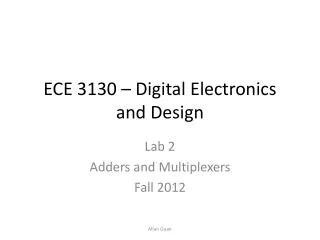
ECE 3130 – Digital Electronics and Design Lab 2 Adders and Multiplexers Fall 2012 Allan Guan
Objectives • Learn how adders and multiplexers work • Build and simulate a half and full adder • Build and simulate a 2-to-1 and 4-to-1 multiplexer Allan Guan
What are adders? • Digital circuits that perform addition of numbers • Half adder • Adds two 1-bit binary numbers • Full adder • Adds three 1-bit binary numbers Allan Guan
Half Adder • Truth table • Implementation Allan Guan
Full Adder • Truth table Allan Guan
Full Adder Implementation • Implementation Allan Guan
Analysis • In addition to the truth table, include the Boolean equation for the sum and carry of the half and full adder. • Report, in tabular form, the propagation delays (tPHL, tPLH) of the sum and carry for the half adder. • Which output has longer delay: sum or carry? Can you say why? Allan Guan
What is a multiplexer (MUX)? • A device with multiple inputs and one output • Also known as a data selector or controlled switch Allan Guan
How does it work? • A MUX has n select lines, 2n inputs and 1 output • The select line chooses which input to pass to the output • 2-to-1 MUX • Truth table Allan Guan
2:1 MUX Gate Implementation Allan Guan
4-to-1 MUX • Truth table Allan Guan
Homework • Build a 2:1 MUX and simulate it • Build a 4:1 MUX from your 2:1 MUX (hint: you will need three 2:1 MUX’s) and simulate it • You will be using the 4:1 MUX next lab Allan Guan