
SlideServe
Menu
Préférences
© SlideServe · v2026

Randy S. Wax, MD, FRCP(C) Technology Application Unit and Critical Care Unit,

elu avatar
49 diapositives · 885 Views · Aug 08, 2014

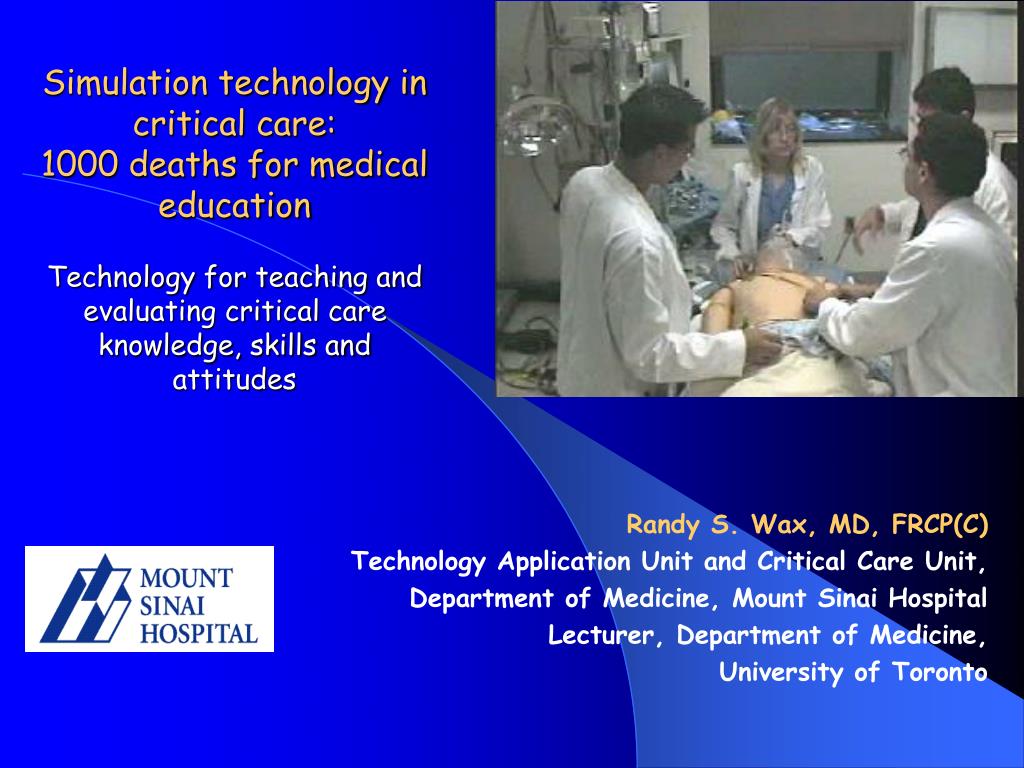
Simulation technology in critical care: 1000 deaths for medical education Technology for teaching and evaluating critical care knowledge, skills and attitudes. Randy S. Wax, MD, FRCP(C) Technology Application Unit and Critical Care Unit, Department of Medicine, Mount Sinai Hospital
Randy S. Wax, MD, FRCP(C) Technology Application Unit and Critical Care Unit, - slide 1
01 / 49Randy S. Wax, MD, FRCP(C) Technology Application Unit and Critical Care Unit,
1 / 17

Télécharger la présentation

Randy S. Wax, MD, FRCP(C) Technology Application Unit and Critical Care Unit,
Une image / un lien ci-dessous est fourni (tel quel) pour télécharger la présentation

Politique de téléchargement : le contenu du site vous est fourni TEL QUEL pour votre information et votre usage personnel ; il ne peut être vendu, concédé sous licence ni partagé sur d’autres sites sans l’accord de son auteur.Le contenu vous est fourni TEL QUEL, pour votre information et votre usage personnel uniquement. Téléchargez la présentation en cliquant sur ce lien. Lors du téléchargement, si vous ne parvenez pas à télécharger une présentation, l’éditeur a peut-être supprimé le fichier de son serveur.Pendant le téléchargement, si vous ne parvenez pas à obtenir une présentation, le fichier a peut-être été supprimé par l’éditeur.

F I N

Plus de contenu associé

Transcription de la présentation
  1. Simulation technology in critical care: 1000 deaths for medical educationTechnology for teaching and evaluating critical care knowledge, skills and attitudes Randy S. Wax, MD, FRCP(C) Technology Application Unit and Critical Care Unit, Department of Medicine, Mount Sinai Hospital Lecturer, Department of Medicine, University of Toronto

  2. Learning objectives • Why simulation? • Features of a simulator • Apply simulation technology • Limitations and resource requirements

  3. A traditional approach to learning

  4. Problem #1 • Just because students learn a task in the classroom doesn’t mean they can demonstrate successful performance during a crisis.

  5. Problem #2 • Some clinical experiences are so life threatening that students are not going to be involved in the management.

  6. Problem #3 • Some are so rare that the student may not ever experience the situation until they are in the midst of caring for the patient.

  7. Different simulation formats • Patient management problems (paper/pen) • Computerized simulation • Internet-based • Role playing/standardized patients • Mannequin-based (e.g., CPR BCLS trainer) • Virtual reality

  8. Why simulation? • Used in many “high reliability” fields • Aviation • Nuclear power • Military flight operations

  9. Why simulation? • No risk to patients • Many scenarios can be presented, including uncommon but critical situations in which a rapid response is needed • E.g. malignant hyperthermia 1:40,000 cases • Participants can see the results of their decisions and actions; errors can be allowed to occur and reach their conclusions

  10. Why simulation? • Identical scenarios can be presented to different clinicians or teams • The underlying causes of the situation are known • With mannequin based simulators clinicians can use actual medical equipment • examine limitations in the human-machine interface

  11. Why simulation? • Re-create clinical environments • Assess interpersonal interactions with other clinical staff • Evaluate and improve teamwork, leadership, and communication skills

  12. Why simulation? • Intensive and intrusive recording of the simulation session is feasible • Audiotape • Videotape • Physiological monitoring of participants (EEG, ECG, etc.)

  13. Why simulation? • There are no issues of patient confidentiality • Recordings can be preserved for research, performance assessment, or accreditation

  14. How can we use simulation? • Skills training • Evaluation • Epidemiology and modification of errors (and their consequences) • Crisis resource management

  15. What can you teach/evaluate? • Specific skills • Intubation • Bronchoscopy • Defibrillation • Integration of knowledge, skills and decision making • Resuscitation • Refractory hypoxemia

  16. Evaluation of the evaluation tool • Type of simulator • Low to high fidelity • Type of simulation • Full theatre environment or real location • Training device for specific tasks • Efficacy of assessment • Valid • Reliable

  17. SIM MAN

  18. Life-size mannequin

  19. Computer Controlled

  20. Teach airway management

  21. Use airway devices

  22. Fibreoptic intubation

  23. Difficult airway • Decreased cervical range of motion • Tongue edema • Pharyngeal edema • Laryngospasm • Trismus • Fiberoptic intubation/bronchoscopy • Surgical airway • Detectable carbon dioxide

  24. Breath sounds

  25. Check pulse & blood pressure

  26. Obtain peripheral IV access

  27. Mask ventilation

  28. Decompress tension pneumothorax

  29. Monitor cardiac rhythm

  30. Shock unstable rhythms

  31. Additional features • Chest tube insertion • Invasive hemodynamics • Ventilator management (including HFOV)

  32. Control crisis situations

  33. Give feedback

  34. Assessment instruments • Specific • Debriefing (oral or written…good for factual) • Observation and scoring system (checklist or score sheet or palm pilot) • Time to performance of specific task • Global • Simulated mortality as end-point • Time to solve problem

  35. How can we use simulation? • Skills training • Evaluation • Epidemiology and modification of errors (and their consequences) • Crisis resource management

  36. Epidemiology of Medical Error • Types of errors made during anaesthesia simulation Schwid and O’Donnell Anesthesiology 1992

  37. Crisis Resource Management • Using all available resources during a crisis to achieve safety and efficiency • Information • Equipment • People

  38. Crisis Resource Management • Error countermeasures • Reduce the frequency of errors • Correct errors • Limit the impact of errors

  39. Resources • Simulator PLUS operational budget • Competency standards • Who/what are you testing? • Content experts • Set objectives and clinical setting • Simulation experts • Translate objectives and clinical setting into functional simulation scenarios • AV equipment (debriefing)

  40. Limitations of simulation • Difficult to demonstrate improved outcome from use of simulation • Adverse events are unusual • Extreme number of potential confounders • Forced to use simulation performance as surrogate outcome

  41. Initiatives at MSH

  42. Initiatives at MSH • Mock cardiac arrests • ACLS protocols • Use of equipment • Systems issues (elevators, cancel arrest) • Crisis resource management • Feedback/debriefing

  43. Initiatives at MSH • Life-saving delegated medical acts • ICU/CCU nurses • Use of epinephrine/atropine • Defibrillation • Pre-ACLS interventions • Bag-valve-mask ventilation • Understanding respiratory failure and shock

  44. Initiatives at MSH • Medical and Critical Care Residents • Continuing education courses • Difficult airway management • Advanced ARDS strategies • Technology evaluation • OCCIN Project Multidisciplinary approach Portable

  45. Parting comments • Simulation is fun for students and teachers • You can use simulation technology as an evaluation tool • Choose the most appropriate tool for achieving educational goals • Remember basics of education, otherwise simulator is an expensive toy