polygons
In this engaging activity, students will explore the concept of polygons by drawing different types of polygons on Post-it notes and sharing their thoughts in pairs. They will learn the defining properties of polygons, distinguishing between convex and concave shapes, as well as regular and irregular polygons. Students will work collaboratively to classify drawings and validate their understanding of diagonals and interior angles in polygons. This hands-on approach enhances their grasp of geometric concepts through creative expression and peer discussion.


polygons
E N D
Presentation Transcript
polygons Chapter 6.1
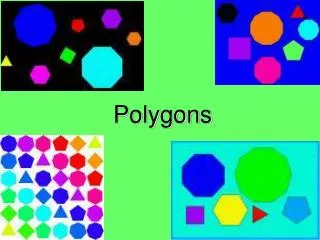
Draw and post • Draw a picture of a polygon on each of your post-it notes. • Try to draw two different types of polygons (be creative). • Post them on the far wall (under “Polygons” sign)
Think/pair/share • Take a minute to think about your drawings, what makes a figure a polygon? • Pair up with someone and share your thoughts. (Be sure to listen to their thoughts as well.) • Write down properties you think must exist to call something a polygon.
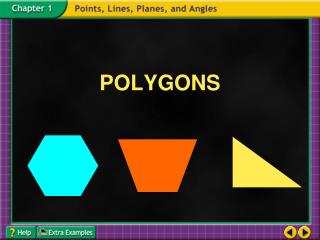
Section 6.1What is a polygon? (Write down) Polygons Not Polygons
A polygon has…(Write Down) • Three or more sides • No curved sides • Each segment connects to only two others (segments don’t cross)
Decide and check • Ones- come up the board and remove any examples from the wallthat you think are not polygonsand put them on the table in front of the computers. • Twos – Check to see if you agree with the drawings that were removed. Then go to the walland make sure that Group1 removed all the drawings that should have been removed.
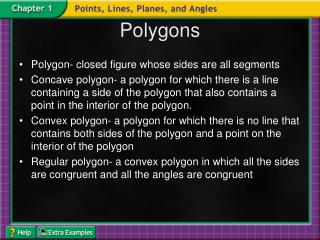
Convex vs concave (Write Down) Convex Polygons Concave Polygons
What’s the difference? Convex Polygons Concave Polygons
Decide and check • Twos– Go to the walland divide the drawings into two groups (Concave/Convex) • Ones– Check to see that the Twosgrouped the drawings correctly
If all the angles in a polygon are equal it’s called • If all the sides in a polygon are equal it’s called • If a polygon is both equilateral and equiangular it is regular(write down) equiangular equilateral
Polygon Names • Polygon Names
Decide and check • Ones– Go to the walland label all the Concave drawings with the appropriate name. • Twos– Go to the wall and label all the Convex drawings with the appropriate name.
Diagonals • A diagonal connects two non-consecutive vertices (write down)
Diagonals • A rectangle has 2 diagonals • Draw the diagonals of a pentagon (5 sides)
Triangles in a polygon • In your notes create a table, the size of a full sheet of paper, that has 4 columns and 12 rows. Leave enough room to draw a picture below the name. (n – 2) x 180 n n - 2
Solve for x • 113+98+42+x=360 • 253+x=360 • X=107
Solve for x • 90+90+2x+25+3x+5=360 • 210+5x=360 • 5x=150 • X=30
Equiangular Polygons • What does each interior angle equal in an equiangular 20-gon? • What does each interior angle equal in an equiangular n-gon? • Use this formula to find what each interior angle equals in an equiangular 40-gon.
Exit Ticket: (Index Card)Remember to write your name! • First: Name the Polygon. • Second: Determine whether the polygon is convex or concave. • Third: Determine whether the polygon is equilateral, equiangular, regular, or neither. • Fourth: Solve for x. x x x x 6.1 Homework (per website/ assignment sheet) is due on Monday!