Understanding Polygons: Types, Properties, and Perimeter Calculation
Polygons are closed figures made of line segments with specific properties. To qualify as a polygon, it must have sides that connect at endpoints and not be collinear, intersecting exactly two other sides. Polygons are named based on the number of their sides: triangle (3), quadrilateral (4), pentagon (5), hexagon (6), heptagon (7), octagon (8), nonagon (9), decagon (10), dodecagon (12), and n-gon for polygons with n sides. Regular polygons are convex with equal sides and angles. Learn how to calculate the perimeter of polygons, such as triangle ABC.


Understanding Polygons: Types, Properties, and Perimeter Calculation
E N D
Presentation Transcript
Polygon • Closed figure whose sides are all segments. • To be a Polygon 2 things must be true • Sides have common endpoints and are not collinear • Sides intersect exactly two other sides
Naming a Polygon • The sides of each angle in a polygon are the sides of the polygon • The vertex of each angle is a vertex of the polygon • They are named using all the vertices in consecutive order
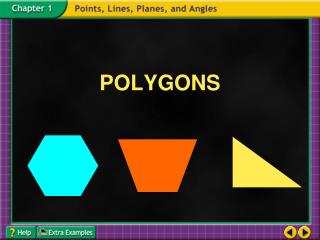
The number of sides determines the name of the polygon • 3 - Triangle • 4 - Quadrilateral • 5 - Pentagon • 6 - Hexagon • 7 - Heptagon • 8 - Octagon • 9 - Nonagon • 10 - Decagon • 12 - Dodecagon • Anything else …. N - gon (where n represents the number of sides)
Regular Polygon • A regular polygon is a convex polygon whose sides are all congruent and whose angles are all congruent
Perimeter • The perimeter of a polygon is the sum of the lengths of its sides.
Perimeter of the Coordinate Plane • Find the perimeter of the triangle ABC with A(-5,1), B(-1,4), C(-6,-8)