
Understanding Acids and Bases: Jeopardy Review PowerPoint
E N D
Presentation Transcript
POWERPOINT JEOPARDY Properties 11.2 Calcs Titration Titration Calculations Definitions 10 10 10 10 10 20 20 20 20 20 30 30 30 30 30 40 40 40 40 40 50 50 50 50 50
True or False: Only bases conduct electricity.
Explain or draw what is happening on the molecular level when a solution is neutralized.
If a solution has a pH of 8, is it an acid, base, or neutral?
In a neutralization reaction, what two products are always formed?
The titrant is always placed in the (buret or Erlenmeyer flask).
Predict the products and balance the equation KOH + H3PO4
Determine the concentration of 25.0 mL of HCl by neutralizing it with 32.18 mL 0.150 M KOH.
In a titration, 22.17 mL of 0.220 M HNO3 was neutralized by 13.23 mL of Ba(OH)2. What is the concentration of the base?
What volume of 0.150 M NH4OH solution will neutralize 10.00 mL of a 0.3 M HCl solution?
13.88 mL of 1.50 NaOH solution neutralizes 27.76 mL of 0.250 M acid solution. Is the acid HCl or H3PO4 ?
2 L of 0.236 M KOH is added to 800 mL of H2SO4. What is the concentration of the acid?
Why is universal indicator sometimes considered an advantage over phenolphthalein?
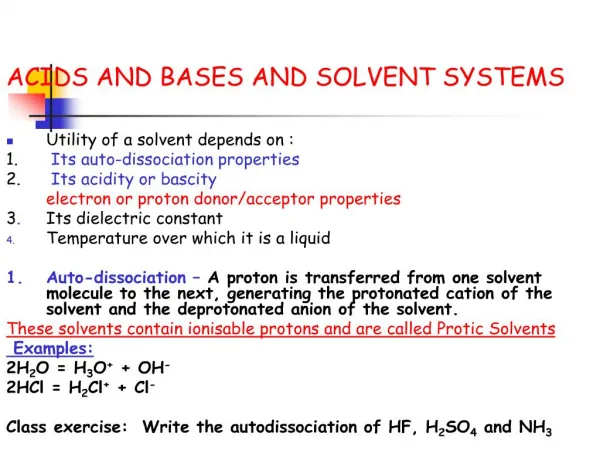
When an acid or base breaks apart into ions this is called _____________ or ________________.
What is the difference between an Arrhenius Base and a Bronsted – Lowery Base?
Identify the A, B, CA, and CB in the reaction below: NH3 + H2O NH4+ + OH-