Intro to Viruses
This introductory overview presents the fundamental aspects of viruses, including their structure, classification as non-living entities, and mechanisms of reproduction. Viruses are defined as particles composed of nucleic acid and proteins that cannot replicate independently and must invade living cells to reproduce. We explore their typical compositions, such as DNA or RNA surrounded by protein coats (capsids), and delve into retroviruses, which integrate their RNA into the host’s DNA. Understanding these elements is crucial for studying their impact on health and disease.

Intro to Viruses
E N D
Presentation Transcript
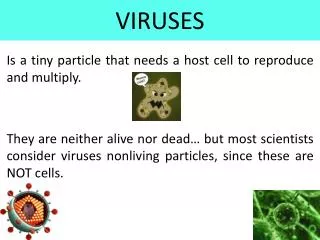
Learning Objectives - Viruses • Be able to • Describe the basic structure of a virus • Explain why viruses are classified as non-living
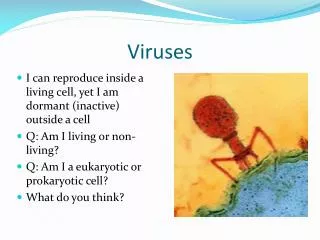
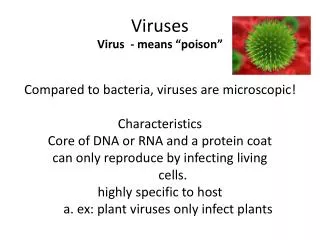
What are Viruses? • Particles of nucleic acid, protein and in some cases, lipids • Reproduce by infecting living cells • Differ widely in terms of size and structure • Enter cells and use the machinery of the infected cell to produce more viruses
Are Viruses Living? • According to the online Merriam-Webster Dictionary life is • “an organismic state characterized by capacity for metabolism, growth, reaction to stimuli, and reproduction.” • Viruses are NOT living things • Complicated assemblies of molecules (including proteins, nucleic acids) • Cannot do anything on their own – they MUST enter a living cell • Without cells, viruses would not be able to multiply
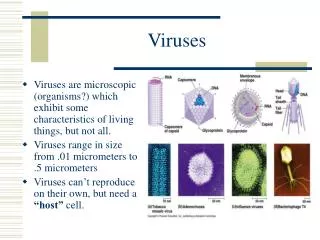
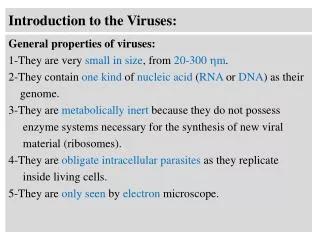
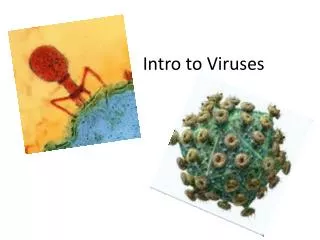
Virus Structure • Typical virus is made of • Core DNA or RNA • Surrounded by protein coat • (sometimes) contain layer of fat • Simplest viruses contain a few genes • Most complex can have > 100 genes
Protein coat of a virus is called it’s capsid • Includes proteins that enable a virus to enter host cell
Capsid proteins of viruses bind to receptors on cell’s surface • They “trick” the cell into allowing it inside • Once inside, the viral genes are expressed • Cell transcribes and translates the viral genetic information into viral capsid proteins
What is it? • Contain RNA as their genetic material • Genetic information is copied backwards • From RNA to DNA (instead of DNA to RNA) • Retro = backward • Responsible for some types of cancers in animals, humans • Causes AIDS
Infect cells • Produce a DNA copy of their RNA • Insert this DNA into host cell • Dormant before active • Production of new virus results in death of host cell