Understanding Verbs: The Backbone of Language
170 likes | 287 Vues
Verbs are essential components of speech that help us communicate effectively. This resource explores the different types of verbs, including action verbs that denote doing, being verbs that express states of existence, linking verbs that connect ideas, and helping verbs that support main verbs. Furthermore, it discusses regular and irregular verbs, demonstrating their principal parts with examples. Knowing what a verb is allows us to construct meaningful sentences and enrich our language comprehension.


Understanding Verbs: The Backbone of Language
E N D
Presentation Transcript
Verbs Mrs. Wright
Why is it important to know what a verb is? • One of the 8 parts of speech • Help us understand the language better • You cannot have a sentence without a verb • You MUST have it to make a sentence
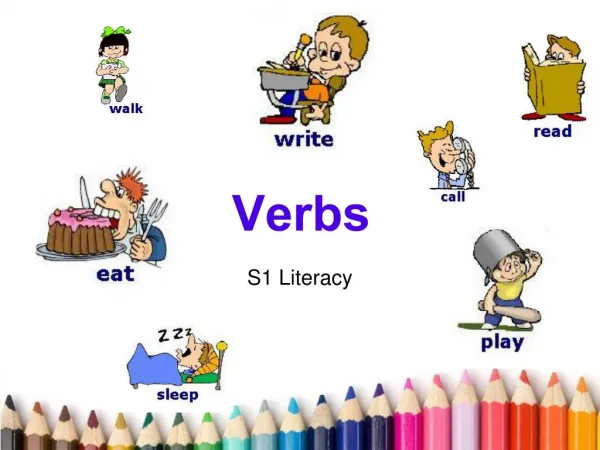
Action Verbs • The state of doing something • (easy) • Examples • Skip • Hop • Cry • Laugh • Think
Being Verbs • Not all verbs show action • To be is a verb that does not show action • Forms of “to be”: • Am • Is • Are • Was • Were • Be • Being • Been
Linking Verbs • Verbs that do not show action • Can stand by itself • We use linking verbs in our writing all of the time • Am • Is • Are • Was • Were • Be • Being • Seem • Become
Helping Verbs • A sentence may have a main verb and a helping verb • Come in the forms of: • Have • Have, has, had • Do • Do, does, did • Be • Be, am, is, are, was were, being, been • Example: • Tom dances (MAIN VERB) the best of all my friends • Tom is (HELPING VERB) dancing with his girlfriend
Command Verbs • Command verbs can be a sentence all by itself • This form of conversation is used a lot • Examples: • STOP! • LOOK! • LISTEN!
Principal Parts • Each verb has four main parts: • Infinitive • Today • Present participle • (-ing) • Past • (Yesterday) • Past Participle • Has, have, had
Principal Parts (walk) • Infinitive • To walk • Present (today) I walk • Present Participle (-ing) • I walking? • I am walking • (am = linking verb) • Past (yesterday) • I walked • Past Participle (has, have, had) • Helper + walked • I have walked
Principal Parts (talk) • Infinitive • To talk • Present (today) • I walk • Present Participle (-ing) • I talking? • I am talking • (am = linking verb) • Past (yesterday) • I talked • Past Participle (has, have, had) • Helper + talked • I have talked
Regular Verbs • Follow regular patterns • Today I walk • I am walking • Yesterday I walked • I have walked • Today I talk • I am talking • Yesterday I talked • I have talked • Just add an –ED to the past and past participle
Regular Verbs with Spelling Issues (Cry) • Infinitive • To cry • Present (today) • I cry • Present Participle (-ing) • I crying? • I am crying • (am = linking verb) • Past (yesterday) • I cred? • I cryed? • I cried • Past Participle (has, have, had) • Helper + cried • I have cried
Regular Verbs with Spelling Issues (Try) • Infinitive • To try • Present (today) • I try • Present Participle (-ing) • I trying? • I am trying • (am = linking verb) • Past (yesterday) • I tred? • I tryed? • I tried • Past Participle (has, have, had) • Helper + tried • I have tried
Irregular verbs • Do not follow regular patterns (those are easy) • Irregular verbs follow IRREGULAR patterns
Irregular Verbs (eat) • Which one does not sound right? • Today I eat • (Present) • I am eating • (Present participle) • Yesterday I eated • (Past) • I have already eaten • (Past participle) • What type of people can get away with that? • Why?
Irregular Verbs (eat) • Today I eat • (Present) • I am eating • (Present participle) • Yesterday I ate • Past • I have already eaten • Past participle
Remember! What you say may not always be what you SHOULD use!