Analysis of Performance
This comprehensive guide delves into the performance analysis of algorithms, focusing on critical aspects such as running time, efficiency, and comparison between different algorithms. We explore exact and asymptotic analyses, detailing the significance of worst-case scenarios and the impact of various input sizes on performance. The importance of experimental studies in understanding algorithms is highlighted, alongside practical implementation challenges. By using Big-Oh notation, we can categorize growth rates and assess the efficiency of algorithms across diverse computational problems.

Analysis of Performance
E N D
Presentation Transcript
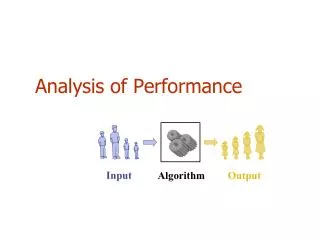
Analysis of Performance Input Algorithm Output
Talking about Performance • Models • Exact • Asymptotic • Experiments • Time • Speedup • Efficiency • Scale-up Analysis of Performance
How would you compare? • Sort Code A vs. Sort Code B? • Algorithm A vs. Algorithm B? • What does it mean to be • a “Good Code”? • a “Good Algorithm”?
Running Time • The running time of an algorithm varies with the input and typically grows with the input size • Average case difficult to determine • We focus on the worst case running time • Easier to analyze • Crucial to applications such as games, finance and robotics
Experimental Studies • Write a program implementing the algorithm • Run the program with inputs of varying size and composition • Use “system clock” to get an accurate measure of the actual running time • Plot the results
What Experiments? Example: Updating an OLAP Cube New Tables Existing Tables
Limitations of Experiments • It is necessary to implement the algorithm, which may be difficult • Results may not be indicative of the running time on other inputs not included in the experiment. • In order to compare two algorithms, the same hardware and software environments must be used
Asymptotic Analysis • Uses a high-level description of the algorithm instead of an implementation • Takes into account all possible inputs • Allows us to evaluate the speed of an algorithm independent of the hardware/software environment • A back of the envelope calculation!!!
The idea • Write down an algorithm • Using Pseudocode • In terms of a set of primitive operations • Count the # of steps • In terms of primitive operations • Considering worst case input • Bound or “estimate” the running time • Ignore constant factors • Bound fundamental running time
Basic computations performed by an algorithm Identifiable in pseudocode Largely independent from the programming language Exact definition not important (we will see why later) Examples: Evaluating an expression Assigning a value to a variable Indexing into an array Calling a method Returning from a method Primitive Operations
By inspecting the pseudocode, we can determine the maximum number of primitive operations executed by an algorithm, as a function of the input size AlgorithmarrayMax(A, n) # operations currentMaxA[0] 2 fori1ton 1do 2+n ifA[i] currentMaxthen 2(n 1) currentMaxA[i] 2(n 1) { increment counter i } 2(n 1) returncurrentMax 1 Total 7n 1 Counting Primitive Operations
Algorithm arrayMax executes 7n 1 primitive operations in the worst case Define a Time taken by the fastest primitive operation b Time taken by the slowest primitive operation Let T(n) be the actual worst-case running time of arrayMax. We havea (7n 1) T(n)b(7n 1) Hence, the running time T(n) is bounded by two linear functions Estimating Running Time
Growth Rate of Running Time • Changing the hardware/ software environment • Affects T(n) by a constant factor, but • Does not alter the growth rate of T(n) • The linear growth rate of the running time T(n) is an intrinsic property of algorithm arrayMax
Which growth rate is best? • T(n) = 1000n + n2 or T(n) = 2n + n3
Growth Rates • Growth rates of functions: • Linear n • Quadratic n2 • Cubic n3 • In a log-log chart, the slope of the line corresponds to the growth rate of the function
Constant Factors • The growth rate is not affected by • constant factors or • lower-order terms • Examples • 102n+105is a linear function • 105n2+ 108nis a quadratic function
Big-Oh Notation • Given functions f(n) and g(n), we say that f(n) is O(g(n))if there are positive constantsc and n0 such that f(n)cg(n) for n n0 • Example: 2n+10 is O(n) • 2n+10cn • (c 2) n 10 • n 10/(c 2) • Pick c = 3 and n0 = 10
Big-Oh Notation (cont.) • Example: the function n2is not O(n) • n2cn • n c • The above inequality cannot be satisfied since c must be a constant
Big-Oh and Growth Rate • The big-Oh notation gives an upper bound on the growth rate of a function • The statement “f(n) is O(g(n))” means that the growth rate of f(n) is no more than the growth rate of g(n) • We can use the big-Oh notation to rank functions according to their growth rate
Questions • Is T(n) = 9n4 + 876n = O(n4)? • Is T(n) = 9n4 + 876n = O(n3)? • Is T(n) = 9n4 + 876n = O(n27)? • T(n) = n2 + 100n = O(?) • T(n) = 3n + 32n3 + 767249999n2 = O(?)
Classes of Functions • Let {g(n)} denote the class (set) of functions that are O(g(n)) • We have{n} {n2} {n3} {n4} {n5} … where the containment is strict {n3} {n2} {n}
Big-Oh Rules • If is f(n) a polynomial of degree d, then f(n) is O(nd), i.e., • Drop lower-order terms • Drop constant factors • Use the smallest possible class of functions • Say “2n is O(n)”instead of “2n is O(n2)” • Use the simplest expression of the class • Say “3n+5 is O(n)”instead of “3n+5 is O(3n)”
Asymptotic Algorithm Analysis • The asymptotic analysis of an algorithm determines the running time in big-Oh notation • To perform the asymptotic analysis • We find the worst-case number of primitive operations executed as a function of the input size • We express this function with big-Oh notation • Example: • We determine that algorithm arrayMax executes at most 7n 1 primitive operations • We say that algorithm arrayMax “runs in O(n) time” • Since constant factors and lower-order terms are eventually dropped anyhow, we can disregard them when counting primitive operations
Rank From Fast to Slow… • T(n) = O(n4) • T(n) = O(n log n) • T(n) = O(n2) • T(n) = O(n2 log n) • T(n) = O(n) • T(n) = O(2n) • T(n) = O(log n) • T(n) = O(n + 2n) Note: Assume base of log is 2 unless otherwise instructed i.e. log n = log2 n