Download
1 / 31
310 likes | 449 Vues
This overview explores the essential process of photosynthesis, detailing why and how it occurs, as well as where it takes place in plants. Key organisms involved in photosynthesis include green plants, phytoplankton, and cyanobacteria, which together provide half of the world's atmospheric oxygen. The role of photosynthetic pigments, particularly chlorophyll, and carotenoids is examined to understand their function in light absorption. Additionally, the methods for measuring photosynthesis rates and the impact of limiting factors like temperature and light intensity are discussed, laying groundwork for experimental design.

E N D
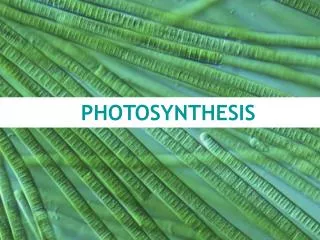
Which organisms can photosynthesise? • Green plants, phytoplankton and cyanobacteria • Phytoplankton and cyanobacteria supply half of all atmospheric oxygen • ‘Red tides’ are caused by photosynthetic protists
Photosynthetic pigments • A pigment is a substance that absorbs light • Plants have pigments in the thylakoids of their chloroplasts: chlorophylls, carotenoids and • Chlorophyll a is directly involved in photosynthesis while chlorophyll b is an accessory pigment, since it assists in capturing light energy • Caratenoids give leaves their red, orange and brown hues during autumn • Why are leaves green?
Carbon dioxide is often a limiting factor on the rate of photosynthesis
Measuring the rate of photosynthesis • P. 77 in textbook • Oxygen production: ‘direct measurement’ • Carbon dioxide measurement: ‘Direct measurement’ • Biomass measurement: ‘indirect measurement’
Your next IA • ‘Design an experiment which evaluates the effect of ONE limiting factor (temperature, light intensity, light colour or carbon dioxide concentration’ on the rate of photosynthesis’ • You may want to compare different types of plants in your experiment…