Understanding Prairie Dog Behavior: Predation and Survival Strategies
In this video, we explore the fascinating behavior of prairie dogs, focusing on their response to predation and the impact of their actions on family and population dynamics. We discuss how behaviors are categorized into innate and learned, examining survival strategies like alarm calling and altruism. Essential questions about the causes and effects of these behaviors on survival and reproduction are addressed, emphasizing the importance of social interactions among prairie dogs. Gain a closer look at their instinctual and learned behaviors that aid in their survival.

Understanding Prairie Dog Behavior: Predation and Survival Strategies
E N D
Presentation Transcript
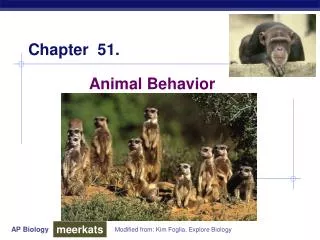
Animal Behavior Chapter 44 Section 1 Pg. 886-892
A Closer Look 1. Identify the: Predator Prey 2. Describe the response to predation. 3. How does this action help their family? 4. Explain how might this benefit the population.
Behavior • What is behavior? • What an animal does and how it does it • An animal’s reaction to stimuli
Essential Questions • What causes the behavior? • Why does a behavior occur? • How does it affect the organisms survival and reproduction?
Survival of the Fittest • Behavior ensures that the individual or group survives to pass on their genes to the next generation • Ex. Male lions kill other baby lions that don’t have their DNA • All behavior has some genetic basis • Ability to learn behavior is inherited • Behavior is modified by the environment
Types of Behavior • Innate (Instincts) • Inherited actions that are performed effectively from birth • Ex. Spiders building webs, cats cleaning • Learned • Actions that change with experience
Learned Behavior 1. Habituation Organism learns to ignore harmless stimuli • Squirrels stop responding to alarm calls if not followed by an attack • You no longer smell a perfume throughout the day How can this help survival and ensure reproduction?
2. Classical Conditioning Animal learns to associate a response with a certain stimulus • Ivan Pavlov’s dog
Figure 51.10 Decisionchamber Food Stimulus Lid Entrance (b) Pattern maze (a) Color maze
3. Operant Conditioning Organism associates some operation (action) with a reward/punishment • Test animals learned to pull levers that yielded food and avoid those that caused electrical shock
4. Problem Solving and Reasoning Ability to solve a problem that has not been encountered before
Group Behaviors • 1. Can be cyclic and develop to changes in the environment • Migration • Hibernation
2. Interaction between 2 or more animals • Flocking • Schooling • Herding • Cooperative hunting • Altruism: an individual sacrifices his survival for the benefit of the group (ex. Prairie dog)