Understanding Howard Gardner's Multiple Intelligences: Roles and Applications
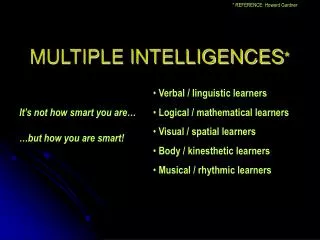
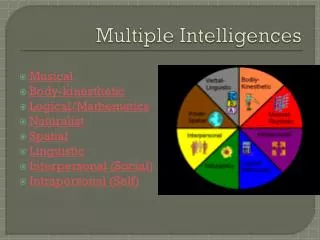
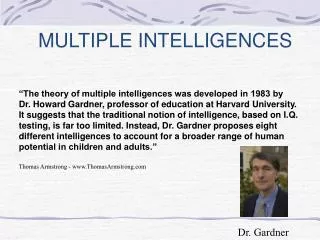
Explore Howard Gardner's theory of Multiple Intelligences, which identifies various ways individuals excel in learning and understanding. This detailed overview covers the eight intelligences: Linguistic, Logical-Mathematical, Musical, Bodily-Kinesthetic, Spatial-Visual, Interpersonal, and Intrapersonal, along with their typical roles in society, such as writers, scientists, musicians, dancers, and educators. By understanding these intelligences, one can recognize personal strengths and the diverse talents that contribute to personal and professional growth.

Understanding Howard Gardner's Multiple Intelligences: Roles and Applications
E N D
Presentation Transcript
Multiple Intelligences Howard Gardner
Linguistic • words and language, written and spoken; retention, interpretation and explanation of ideas and information via language, understands relationship between communication and meaning
Typical Roles • Writers • Lawyers • Journalists • Speakers • Trainers • Copy-Writers • English Teachers • Poets • Editors • Linguists • Translators • PR consultants • Media Consultants • TV and Radio Presenters • Voice-Over Artistes
Logical-Mathematical • logical thinking, detecting patterns, scientific reasoning and deduction; analyse problems, perform mathematical calculations, understands relationship between cause and effect towards a tangible outcome or result
Typical Roles • Scientists • Engineers • Computer Experts • Accountants • Statisticians • Researchers • Analysts • Traders • Bankers Bookmakers • Insurance Brokers • Negotiators • Deal-Makers • Trouble-Shooters • Directors
Musical • musical ability, awareness, appreciation and use of sound; recognition of tonal and rhythmic patterns, understands relationship between sound and feeling
Typical Roles • Musicians • Singers • Composers • DJ's • Music Producers • Piano Tuners • Acoustic Engineers • Entertainers • Party-Planners • Noise Advisors • Voice Coaches
Bodily-Kinesthetic • body movement control, manual dexterity, physical agility and balance; eye and body coordination
Typical Roles • dancers, demonstrators, actors, athletes, divers, sports-people, soldiers, fire-fighters, PTI's, performance artistes; ergonomists, osteopaths, fishermen, drivers, crafts-people; gardeners, chefs, acupuncturists, healers, adventurers
Spatial-Visual • visual and spatial perception; interpretation and creation of visual images; pictorial imagination and expression; understands relationship between images and meanings, and between space and effect
Typical Roles • artists, designers, cartoonists, story-boarders, architects, photographers, sculptors, town-planners, visionaries, inventors, engineers, cosmetics and beauty consultants
Interpersonal • perception of other people's feelings; ability to relate to others; interpretation of behaviour and communications; understands the relationships between people and their situations, including other people
Typical Roles • Therapists • HR professionals • Mediators • Leaders • Counsellors • Politicians • Educators • sales-people • Clergy • Psychologists • Teachers • Doctors • Healers • Organisers • Carers • advertising professionals • coaches and mentors
Intrapersonal • self-awareness, personal cognisance, personal objectivity, the capability to understand oneself, one's relationship to others and the world, and one's own need for, and reaction to change
Typical Roles • arguably anyone who is self-aware and involved in the process of changing personal thoughts, beliefs and behaviour in relation to their situation, and other people.