Center-Level Redundancy, cont.
160 likes | 275 Vues
This document outlines the strategies for center-level redundancy and node-level resiliency to ensure continuous data and service availability. Key components include multiple private and public connections to UCB, automatic failover to diverse internet tunnels, and multiple data and phone line backups including DSL, Frame Relay, and analog. The system incorporates endpoint RAIDs and a deep storage strategy for waveform data to mitigate catastrophic failures. Monitoring systems are in place to notify of extended outages, ensuring robust disaster recovery while complying with operational standards.


Center-Level Redundancy, cont.
E N D
Presentation Transcript
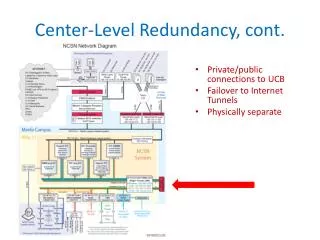
Center-Level Redundancy, cont. • Private/public connections to UCB • Failover to Internet Tunnels • Physically separate
plus 53 DSL, 20 Frame Relay, 124 Internet (NQ), 6 analog phone lines,and NSMP dial-up 10
Node-level Resiliency & Redundancy (cont) • Endpoint RAIDs • deep (~3 mos) Winston tanks of continuous waveform data from all µwave nodes • For catastrophic failure in Menlo • RAID recovery by SneakerNet. • Not a hot standby system as required by NIST. • No satellite, DSL, T1 data • T1 loops • Failover automatically • Monitoring notifies us of extended outages
NCSS* Station Types *Does not include UNR
USGS NCSN (NC) 509
USGS NSMP (NP) 186
CGS (CE) 347
PG&E (PG) 25
Calpine (BG) 32
UNR (NN) ~73
SCSN (CI) ~39
10 NCSS Partners ~1300 stations