Download
1 / 4
40 likes | 149 Vues
In this chapter, we explore the critical period of the Roman Empire's transformation during the 4th and 5th centuries CE. Key events include Constantine's establishment of a new capital at Constantinople, leading to the division of the empire into the Western and Eastern Roman Empires. The chapter discusses the impact of external pressures from Germanic tribes and the Huns, culminating in the sacking of Rome. Various theories surrounding the fall of Rome, including social, political, and health factors, are also examined, with 476 CE marking a significant turning point in this historic decline.

E N D
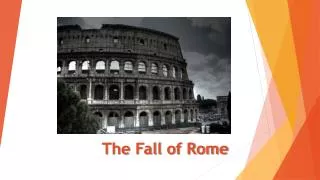
The Fall of Rome Unit 1 Chapter 5 Section 5
The Split of Rome • Constantine’s new project – A new Roman capital • The new capital comes with the split of the Roman Empire • Rome – Western Roman Empire • Polytheism (Multiple Gods) • Constantinople – Eastern Roman Empire • Christianity (Single God)
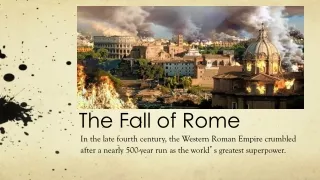
The Germanic Tribes Move In • The Huns, lead by Attila the Hun move in to Eastern Europe • The Huns force other groups to move west and into Rome • Rome is sacked (partially destroyed) throughout the 400’s CE • 476 CE – Romulus Augustulus removed from power • Seen as the date when Rome falls
Why Did Rome Fall – The Theories • Treatment of Christians • Lead Poisoning • Non-Romans and Non-Italians coming to power • Plague • Lack of technological development • Couldn’t create a workable political system