Download

1 / 8
80 likes | 201 Vues
Explore the fascinating beginnings of the Roman Republic, from the myth of Romulus and Remus to the establishment of a powerful military state. Learn how Rome evolved from small villages to a dominant force in central Italy, shaped by influences from Etruscans, Greeks, and Latins. Discover the social structure with Patricians and Plebeians, the significance of the Twelve Tables, and the Republic's military organization. Follow Rome's expansion through the Punic Wars, culminating in the destruction of Carthage and the establishment of Roman dominance.

E N D
Roman Republic “Inter ArmaEnim Silent Leges” -Cicero
The Beginnings of Rome • Myth- Romulus and Remus were twin sons of Mars and a Latin mortal • Abandoned at birth and raised by a she-wolf • Built Rome where they lived • Another possibility • From 1000-500 BCE, three groups settled in the area and fought for control • Latins- settled on either side of the Tiber in Latium • Greeks- established 50 colonies in southern Italy and Sicily 750-600 BCE • Etruscans- native to northern Italy
Rome started as a Clepto • Rome adopted the Etruscan alphabet, architecture style (Arches), and some religious rituals • Roman gods took on the personalities and legends of the Greek gods, but with new names
Early Republic • 600 BCE- an Etruscan becomes king. Over the next 100 years, Rome grows from a couple of villages to a city spanning 500 square miles. • 509 BCE- Tarquin the Proud is removed from power • Romans declared they would put to death anyone who plotted to make themselves a king • Social Classes • Patricians • Aristocratic landowners • Plebeians • Common farmers, merchants, artisans, etc. (Plebs) • Political Power • Only patricians could hold office, ancestry gave them the right to make laws. • Plebs could vote, and were eventually allowed to have a tribune which looked after their rights in the Senate • Only free-born males could vote.
Government Under the Republic • Twelve Tables • 1st Roman written code of laws (451 BCE) were hung in the Forum (central area of the city) • All citizens (pleb and pat) had the right of protection of the law • Structure • Two consuls instead of 1 king. They ran the army and directed the government. (1 yr term/ 10years) • Senate- 300 members selected from Rome’s aristocracy (for life)
The fun part --- Military • All citizens who owned land were required to serve in the military • Certain public offices required 10 years of service • Army organized into legions – 5000 infantry, with a small group of cavalry. • Legions were divided into smaller groups of 80 men called a century • The legion’s strength was its flexibility. Each century could act independently or as part of the legion.
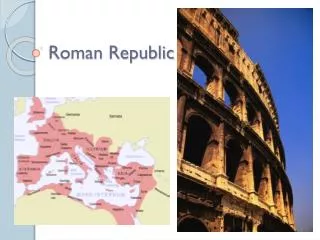
Expansion • By the 4thcentruyBCE, Rome controlled most of central Italy. • Expanded against their rivals, and by 265 BCE, had conquered the Etruscans (N) and the Greek city-states (S) • Conquered rivals fell into 3 categories: • 1) Citizens (only the Latins across the Tiber) • 2) Quasi-Citizens (all the rights of citzenship except vote • 3) Ally of Rome- Rome doesn’t interfere as long as the ally sends troops to fight and signs no treaties with other nations
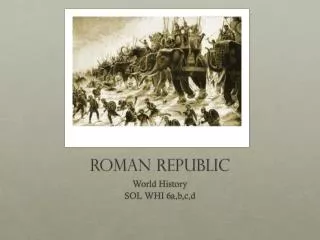
Punic Wars (264-146 BCE) (Carthage) • First Punic War (264-241 BCE) • Siciliy Rome wins • Second Punic War (218-202) BCE • Hannibal and his elephants • Marched from Spain, to France, then invaded northern Italy • Rome only won because to make Hannibal stop, they invaded Carthage • Third Punic War (149-146 BCE) • By this time, Carthage had little to no military, only economic wealth. • Roman senator ended all of his speeches “Carthage must be destroyed!” • 149- Rome lays siege to Carthage • 146- Carthage is burned to the ground, all 50,000 inhabitants are sold into slavery