Download
1 / 20
200 likes | 327 Vues
Explore the critical role of geographic location in the social, economic, and political development of Rome. Learn about the origins of Roman mythology and its lasting impact on later civilizations. Discover how the Roman government evolved towards a more democratic system, including the gradual acquisition of rights by plebeians and significant legal advancements such as the Twelve Tables. Understand the significance of the Punic Wars, where Rome competed with Carthage for control of trade in the Mediterranean, leading to the Republic's transformation into an Empire.

E N D
Roman Republic World History SOL WHI 6a,b,c,d
Essential Questions • How was geographic location important to social, economic, and political development of Rome? • What was the source of Roman mythology? • What impact did Roman mythology have on later civilizations? • How did the government of Rome become more democratic in its decision making?
Roman Government • Plebeians gradually acquired more rights • 450 BCE, the laws of Rome were inscribed on 12 tablets and set up in the Forum • In time plebeians gained the right to elect their own officials called tribunes who could veto laws • Later, plebeians could be elected to the Senate
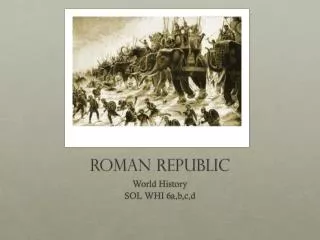
Punic Wars • The Roman Republic fought three wars with the Carthaginian Empire between 264 – 146 BCE called the Punic Wars • Rome and Carthage competed for trade in the Mediterranean • In 218 BCE, Hannibal, a Carthaginian general, crossed the Alps with an army and invaded Italy, but he failed to capture Rome
Outcome of Punic Wars • Carthage was defeated and destroyed • The Roman Republic expanded to North Africa and Spain • The Roman Republic changed to an Empire