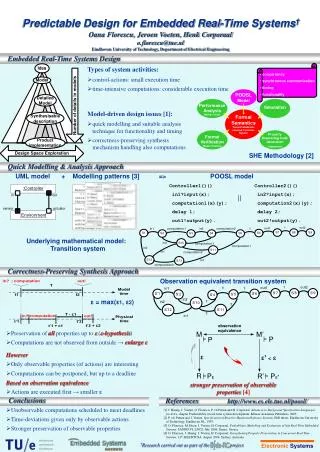

Embedded Real-Time Systems Design
E N D
Presentation Transcript
Embedded Real-Time Systems Design Selecting memory
Memory for embedded systems • Embedded systems have different memory requirements • System frequently don’t have hard disk • No ability to swap • They run unattended • May required unattended boot • Won’t do normal system logging • Power down reliability
Why Flash? EPROM E2PROM Updateable Nonvolatile FLASH DRAM ROM High Density
Why Flash Memory? • Flash has characteristics of both ROM and RAM • It is non-volatile • Can be written to • Has high read access speeds • It is reliable
What is Flash memory? • Flash covers a wide range of different memory technologies and Architectures • DOC (Disc On Chip) system – also known as NAND flash • CFI (Common Flash Interface) – also known as NOR flash • JEDEC – an older standard, still used but becoming obsolete by CFI • Non-DOC Nand • Old non-CFI Flash
Flash memory • Flash memory, both nand and nor, work differently from other memory devices • In many ways they operate as block devices such as disk drives. • The devices are started as a whole series of 1 (empty) • Writing just means resetting the 1s to 0s where necessary
Flash memory • Writing and erasure must be done in blocks • Blocks can vary in size • Nor flash can set individual bits in a block • Nand can have pages in a block to change • Whole blocks have to be erased before they can be written to • Blocks can be locked and unlocked
Common Flash Interface • CFI or the Common Flash Interface was developed by Intel and AMD • The parameters for the flash are stored on chip in a common protocol • Software can query the devices • A number of levels of compliance
Flash Memory Maps • As flash is block orientated it can be laid out in differing ways • Boot flash • With small (normally 8k byte) boot blocks at either top or bottom • Then 64k erase blocks • Flash memory • Arranged in erase blocks of 64 or 128k
Flash limitations • Writing of data can only be done in blocks 9or pages on Nand flash) • Erasing and re-writing is slow • For DOC Nand pages can only be written a limited number of times (10) before block must be erased and re-written • There is a overall limitation on the number of writes – around 100,000 times
Flash file systems • Flash devices have to have separate file systems and devices • On Linux this is the MTD (Memory Technology Device) interface • The file systems need special characteristics • Some devices require a translation layer for a file system to run – FTL (Flash Translation Layer) or NFTL (Nand FTL)
JFFS & JFFS2 • The Journaling Flash File System is a popular choice for flash • It maintains a log structure of the file system in Flash • Loads the file system in to ram a boot time • Does wear levelling – avoids problems of over-writing • Can’t do XIP (eXecute In Place) because of compression/decompression • Not for real-time – garbage collection
CRAMFS • CRAMFS (Compressed RAM File System) • Developed by Linux Torvalds • Compressed version of file system in flash run in ram • Can’t be written to – only remade off-line • Use tmpfs for volatile data