Understanding Albedo: Reflectivity and Insolation in Earth's Climate Zones
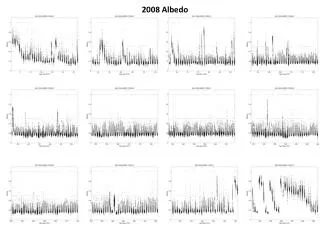
Albedo, the reflectivity of Earth's surface, varies dramatically across geographic regions, with the highest values at the poles and the lowest in tropical and equatorial areas. This phenomenon is particularly pronounced in the southern polar regions compared to the northern ones. Furthermore, understanding where insolation goes is crucial in climate science. Insolation is absorbed and transformed through various processes, including sensible heat flux (changing air temperature), ground heat flux (altering planetary surface temperature), and latent heat flux (changing the state of water without temperature change).

Understanding Albedo: Reflectivity and Insolation in Earth's Climate Zones
E N D
Presentation Transcript
IS ALBEDO (REFLECTIVITY) A GEOGRAPHIC VARIABLE?
1. Greatest at poles, least in tropical and equatorial regions.
Greatest at poles, least in tropical and equatorial regions. Greater in southern polar regions than northern polar regions.
WHERE DOES THE INSOLATION GO? Sinks of Insolation
1. Sensible Heat Flux. 2. Ground Heat Flux. 3. Latent Heat Flux.
1. Sensible Heat Flux. Changing the temperature of the air. 2. Ground Heat Flux. 3. Latent Heat Flux.
1. Sensible Heat Flux. Changing the temperature of the air. 2. Ground Heat Flux. Changing the temperature of the planetary surface. Continents and Oceans 3. Latent Heat Flux.
1. Sensible Heat Flux. Changing the temperature of the air. 2. Ground Heat Flux. Changing the temperature of the planetary surface. Continents and Oceans 3. Latent Heat Flux. Changing the state of water (solid, liquid, gas) without any change in temperature!