SlideServe
Menu
Préférences
© SlideServe · v2026

Tuning Structure of Bimetallic Nanoparticles In Catalysis Applications

eros avatar
1 diapositives · 305 Views · Sep 24, 2014

X19A. Tuning Structure of Bimetallic Nanoparticles In Catalysis Applications. Selim Alayoglu, Peter Zavalij, Bryan Eichhorn, Qi Wang, Anatoly I. Frenkel and Peter Chupas University of Maryland, Yeshiva University and Argonne National Laboratory.
Tuning Structure of Bimetallic Nanoparticles In Catalysis Applications - slide 1
01 / 1Tuning Structure of Bimetallic Nanoparticles In Catalysis Applications
1 / 17

Télécharger la présentation

Tuning Structure of Bimetallic Nanoparticles In Catalysis Applications
Une image / un lien ci-dessous est fourni (tel quel) pour télécharger la présentation

Politique de téléchargement : le contenu du site vous est fourni TEL QUEL pour votre information et votre usage personnel ; il ne peut être vendu, concédé sous licence ni partagé sur d’autres sites sans l’accord de son auteur.Le contenu vous est fourni TEL QUEL, pour votre information et votre usage personnel uniquement. Téléchargez la présentation en cliquant sur ce lien. Lors du téléchargement, si vous ne parvenez pas à télécharger une présentation, l’éditeur a peut-être supprimé le fichier de son serveur.Pendant le téléchargement, si vous ne parvenez pas à obtenir une présentation, le fichier a peut-être été supprimé par l’éditeur.

F I N

Plus de contenu associé

Transcription de la présentation
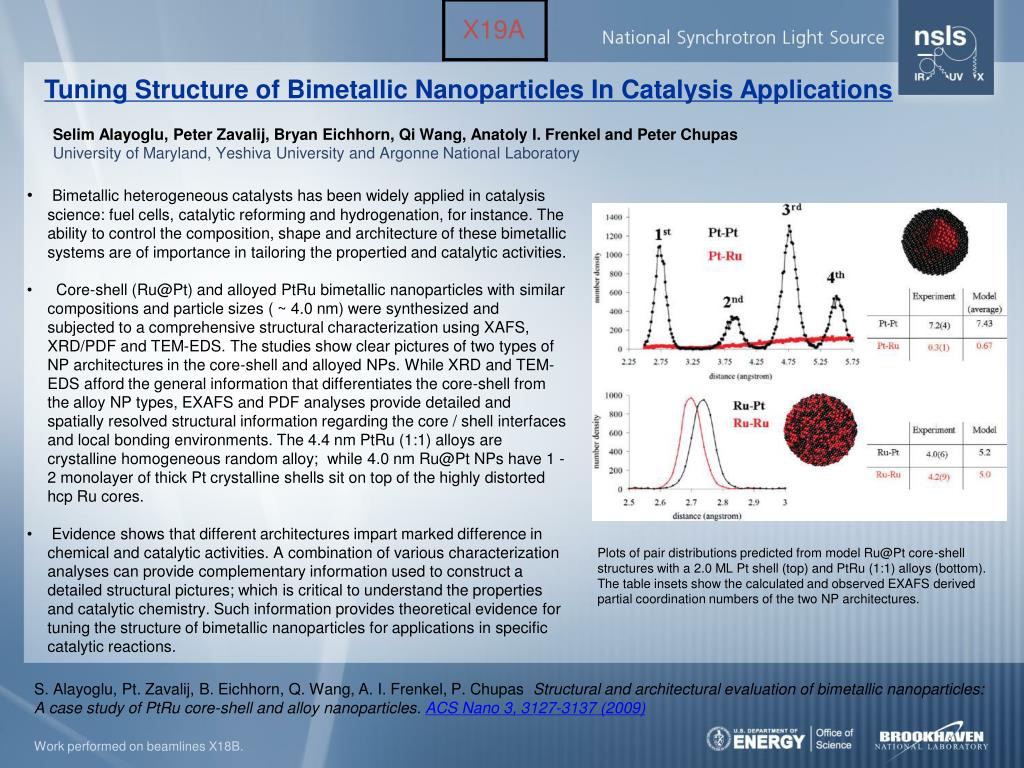
  1. X19A Tuning Structure of Bimetallic Nanoparticles In Catalysis Applications Selim Alayoglu, Peter Zavalij, Bryan Eichhorn, Qi Wang, Anatoly I. Frenkel and Peter Chupas University of Maryland, Yeshiva University and Argonne National Laboratory • Bimetallic heterogeneous catalysts has been widely applied in catalysis science: fuel cells, catalytic reforming and hydrogenation, for instance. The ability to control the composition, shape and architecture of these bimetallic systems are of importance in tailoring the propertied and catalytic activities. • Core-shell (Ru@Pt) and alloyed PtRu bimetallic nanoparticles with similar compositions and particle sizes ( ~ 4.0 nm) were synthesized and subjected to a comprehensive structural characterization using XAFS, XRD/PDF and TEM-EDS. The studies show clear pictures of two types of NP architectures in the core-shell and alloyed NPs. While XRD and TEM-EDS afford the general information that differentiates the core-shell from the alloy NP types, EXAFS and PDF analyses provide detailed and spatially resolved structural information regarding the core / shell interfaces and local bonding environments. The 4.4 nm PtRu (1:1) alloys are crystalline homogeneous random alloy; while 4.0 nm Ru@Pt NPs have 1 -2 monolayer of thick Pt crystalline shells sit on top of the highly distorted hcp Ru cores. • Evidence shows that different architectures impart marked difference in chemical and catalytic activities. A combination of various characterization analyses can provide complementary information used to construct a detailed structural pictures; which is critical to understand the properties and catalytic chemistry. Such information provides theoretical evidence for tuning the structure of bimetallic nanoparticles for applications in specific catalytic reactions. Plots of pair distributions predicted from model Ru@Pt core-shell structures with a 2.0 ML Pt shell (top) and PtRu (1:1) alloys (bottom). The table insets show the calculated and observed EXAFS derived partial coordination numbers of the two NP architectures. S. Alayoglu, Pt. Zavalij, B. Eichhorn, Q. Wang, A. I. Frenkel, P. Chupas Structural and architectural evaluation of bimetallic nanoparticles: A case study of PtRu core-shell and alloy nanoparticles. ACS Nano 3, 3127-3137 (2009) Work performed on beamlines X18B.