Cold War
Chapter 18 of U.S. History provides an in-depth analysis of the Cold War rivalry between the United States and the Soviet Union from 1945 to 1991. Explore key concepts including democracy vs. totalitarianism, containment strategies like the Truman Doctrine and Marshall Plan, and pivotal events such as the Berlin Airlift and McCarthyism. Understand the emergence of NATO and the impact of leaders like Truman and Eisenhower in shaping U.S. foreign policy against communism. This chapter highlights the extensive measures taken to prevent the spread of communist influence globally.

Cold War
E N D
Presentation Transcript
Cold War U.S. History Chapter 18
United States vs. Soviet Union • United States: • Democracy • Private citizens control economic activity • People elect government official with political parties – offers a CHOICE • Soviet Union: • State-controlled property and economic activity • Totalitarian – NO CHOICE • Upset over no 2nd Front, secret atomic bomb
United Nations • 50 nations • Promote peace • San Francisco meeting • Competition between the U.S. and Soviet Union
Potsdam Conference • July 1945 – U.S., GB, S.U. • Final war-time conference • Clear Stalin NOT allowing free elections in Poland like he promised at Yalta • Showed U.S./S.U. at big odds • So.. • Truman fought against large reparations from Germany
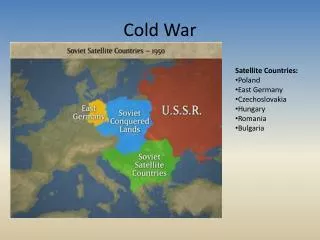
Satellite Nations • Page 605 • Countries dominated by the Soviet Union – communist governments established
Containment ** • Taking measures to prevent communism from spreading to other countries – “containing” it where it exists • George Kennan
“Iron Curtain” • Winston Churchill • Refers to the division between democratic Western Europe and Communist Eastern Europe
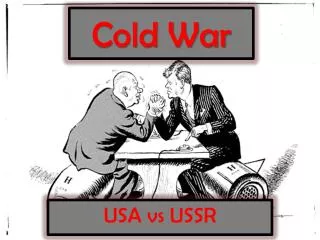
The Cold War • Conflict between the U.S. and the S.U. that does not take place on a battlefield • 1945 – 1991 (when S.U. breaks up)
Truman Doctrine • Greece and Turkey – civil wars – communists vs. pro-western governments. Fall of either opens up Western Europe and Asia to Soviet influence • Truman Doctrine - $400 million in aid to Greece and Turkey. • Why? U.S. must support free people everywhere from outside pressure
Marshall Plan • Western Europe torn up! • Sec. of State George Marshall – give aid to European nations that need it • 16 nations - $13 billion over 4 years • Promoted democracy • Our industries/banks profited
German reunification • 4 zones – GR, FR, US combine their areas – Democratic • Western Berlin – cut off by S.U. • Berlin Airlift – 327 days – U.S. airlifts food, supplies • Increased our prestige • Protected flights with threat of bomb! • Germany – Western part – The Federal Republic of Germany. Eastern part – German Democratic Republic
NATO • North Atlantic Treaty Organization • 12 nations • Defensive military alliance • **1st peacetime alliance for the U.S. • **end of isolationism
China • National government led by Chiang Kai-shek, supported by the U.S. • Sent $3 billion to help fight communist take over. He had no public support though. • Mao Zedong – Communist leader – won people’s support, defeated Kai-shek, est. the People’s Republic of China
Korea • 38th parallel – North – Soviet, South – American controlled • KNOW MAP PAGE 613 • General Douglas MacArthur – commander of troops • Wanted to invade China, Truman rejected idea, MacArthur spoke out against Truman, fired
Executive Order 9835 • Called for loyalty boards for government employees. • 91 organizations labeled “subversive” – watched members • 3.2 million investigated, not allowed to see evidence against them
HUAC • House Un-American Activities Committee – investigated communism in the movie industry • “Hollywood 10” – 10 screen writers, producers, directors – associated with communism
McCarran Act • Against the law to establish a totalitarian government in the U.S. • Required Communist organizations to register with the government
Alger Hiss • Accused of being a Soviet spy • Guilty, prison
Rosenberg’s • Sept. 1949 – Soviets exploded an atomic bomb. How so fast??? • Jan. 1950 – Truman orders creation of hydrogen bomb – finished in ‘52. Soviets do the same 9 months later • Ethel and Julius Rosenberg – accused of leaking atomic secrets to the Soviets • Guilty, put to death in electric chair
McCarthyism • Joseph McCarthy – Rep Senator – accused government employees of being members of Communist party (205 names) • Later charged the Army of being filled with communists – put on trial – TV • Lost a lot of support • McCarthyism – public charges of disloyalty in the government without evidence
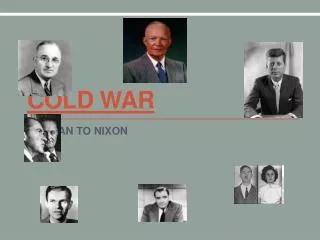
Dwight D. Eisenhower • 1952 election • 1956 election
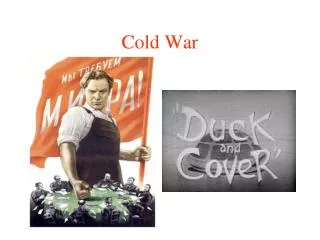
John Foster Dulles • Secretary of State • “Massive Retaliation” – use ALL force to stop communism • “Brinkmanship” – going to the brink of war with S.U. to keep peace – relies on nuclear weapons • Fear of nuclear war comes home – air raid procedures, fall-out shelters
CIA • Central Intelligence Agency – spies, information. • Secret operations to weaken/overthrow unfriendly governments • PAGE 623 - 624
Warsaw Pact • 1953 – Stalin dies • Nikita Khrushchev took over – “Peaceful Co-existence” • Warsaw Pact – S.U. and 7 Eastern European countries
“Spirit of Geneva” • Meeting between Eisenhower/Khrushchev. Wanted “open skies” – does not get, but does get an agreement to stop nuclear testing
Eisenhower Doctrine • U.S. would defend any Middle Eastern nation against any Communist nation • Hungarian Revolt – Hungary revolted against S.U., denounced Warsaw Pact. Soviet tanks rolled in, 30,000 killed. 200,000 fled. • U.S. did nothing, UN did nothing – it was a satellite nation
The Space Race • Sputnik – artificial satellite launched by Soviets • Increase in education – science and math • CIA – making secret flights over Soviet territory taking photos • May 1, 1960 – U-2 plane shot down, evidence of spying shown to world • We agree to stop spying • Caused the ‘60s to begin with tension!!!
1960 Election • Republican – Richard Nixon • Democrat – John F. Kennedy • Things that cost Republicans – Sputnik, long range missiles, U-2 spy plane, Cuba and Soviet Union • TV and Civil Rights turned the election: • TV – 4 debates where JFK looked more “polished” than Nixon • Civil Rights – MLK arrested in Atlanta. Eisenhower did nothing, Kennedy got him out of jail
Kennedy wins by small margin – just over 100,000 popular votes
A New Military Policy • Flexible Response – less reliance on nuclear weapons, increase spending on conventional arms and mobile military • Created the Green Berets
Cuba • 1959 – Fidel Castro came to power • Nationalized American-owned businesses/property • Eisenhower cut off trade • Castro turned to Soviet Union • Est. a communist Totalitarian government • Eisenhower – train anticommunist Cuban exiles to retake Cuba
Bay of Pigs • April 17, 1961 – 1,300 to 1,500 Cubans exiles trained by the CIA landed at Bay of Pigs • Nothing went as planned, trapped by Cubans backed with Soviet tanks • Forced to surrender • Made us look BAD
Cuban Missile Crisis • Oct. 1962 – spy photos show Soviet missile bases in Cuba, some with missiles ready to launch • Page 675 • Oct. 22 – “any attack from Cuba would trigger an all-out attack on the Soviet Union”
For 6 days – Soviet ships heading toward Cuba, naval blockade around Cuba, 100,000 troops sent to Florida • “Eyeball to eyeball” • S.U. backed down
Khrushchev – removed missiles from Cuba • Kennedy – will not attack Cuba, removed missiles from Turkey • Both sides criticized • Hot line established • Nuclear Test Ban Treaty – end testing of nuclear weapons in the atmosphere
Berlin Wall • U.S. troops still in Berlin • People still escaping from east to west • Khru – ordered us to leave, JFK – no. • August 1961 – Berlin wall built • Symbol of the Cold War
The Vietnam War Years U.S. History Chapter 22
Moving Toward Conflict • French controlled Vietnam until WWII • Ho Chi Minh – leader of Vietnamese Communist Party • Japan took over Vietnam • Ho Chi Minh returned and helped from the Vietminh – determined to gain independence • Japanese left after WWII, Ho Chi Minh declared Vietnam an independent nation
French send troops, gain control of Southern half • 1950 – U.S. sends nearly $15 million in economic aid to France • Domino Theory – Eisenhower – if one nation falls to communism they all will fall (just like dominos) • French surrendered May 1954
Geneva Accords – temporarily divided Vietnam along the 17th parallel – Communist north, nationalists south. Election to unify the country would be held in 1956
The United States Steps In • Ho Chi Minh – North Vietnam • Ngo Dinh Diem – South Vietnam – strong anticommunist • Diem refused to take part in the elections • Vietcong – Communist opposition group in the South – began attacking Diem’s government
Kennedy and Vietnam • Increased financial aid to Diem • Sent military advisors to train South Vietnamese troops (16,000 by 1963) • Diem becoming unpopular • Corruption • Moved villagers from their homes • Attacked Buddhism
Diem had to go • Nov. 1, 1963 – U.S. supported military coup overthrew Diem, Diem killed.
Johnson Expands the Conflict • Unstable leadership in South Vietnam • Aug. 2, 1964 – U.S. destroyer fired on by North Vietnamese • Johnson called for bombing strikes on N.V. • Tonkin Gulf Resolution– granted Johnson broad military powers in Vietnam • Operation Rolling Thunder – sustained bombing of North Vietnam • Troops began arriving