Understanding Assembly Language Operators: TYPE, LENGTH, SIZE, and Control Flow Instructions
This guide provides an overview of essential assembly language operators such as TYPE, LENGTH, and SIZE, as defined in Kip R. Irvine's "Assembly Language For Intel-Based Computers." It explains how the TYPE operator returns the size (in bytes) of a data element, LENGTH counts the number of individual elements in a data label using the DUP operator, and SIZE calculates the product of TYPE and LENGTH. Additionally, it covers the JMP and LOOP instructions, including distance modifiers and examples of unconditional jumps and loops for counting operations in assembly programming.

Understanding Assembly Language Operators: TYPE, LENGTH, SIZE, and Control Flow Instructions
E N D
Presentation Transcript
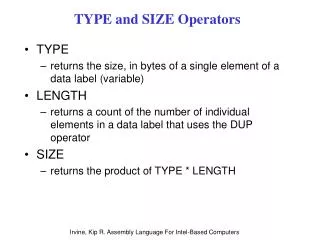
TYPE and SIZE Operators • TYPE • returns the size, in bytes of a single element of a data label (variable) • LENGTH • returns a count of the number of individual elements in a data label that uses the DUP operator • SIZE • returns the product of TYPE * LENGTH Irvine, Kip R. Assembly Language For Intel-Based Computers
TYPE TYPE returns the size attribute: .data myByte db 1,2,3,4 myWord dw 1000h,2000h,3000h myDouble dd 12345678h myQuad dq 1,2,3 .code mov ax,TYPE myByte ; 1 mov ax,TYPE myWord ; 2 mov ax,TYPE myDouble ; 4 mov ax,TYPE myQuad ; 8 Irvine, Kip R. Assembly Language For Intel-Based Computers
LENGTH Returns a count of the number of individual elements in a data label that uses the DUP operator: .data myByte db 20 dup(?) myWord dw 5 dup(0) .code mov ax,LENGTH myByte ; 20 mov ax,LENGTH myWord ; 5 Irvine, Kip R. Assembly Language For Intel-Based Computers
SIZE Returns TYPE multiplied by LENGTH: .data myByte db 20 dup(?) myWord dw 5 dup(0) .code mov ax,SIZE myByte ; 20 (20 * 1) mov ax,SIZE myWord ; 10 (5 * 2) Irvine, Kip R. Assembly Language For Intel-Based Computers
JMP and LOOP Instructions • JMP is an unconditional jump to a code label • LOOP creates a counting loop, using CX as the default counter • LOOPD uses ECX as the counter register • LOOPW uses CX as the counter register • (only necessary in 32-bit mode programming) Irvine, Kip R. Assembly Language For Intel-Based Computers
JMP: Distance Modifiers • JMP SHORT destination • +/- 127 bytes • JMP NEAR PTR destination • same code segment • (default in the small and compact memory models) • JMP FAR PTR destination • different code segment • (default in the large, medium, and huge memory models) Irvine, Kip R. Assembly Language For Intel-Based Computers
JMP Example Label1: . . jmp Label1 Unconditional Transfer of control to a label: Irvine, Kip R. Assembly Language For Intel-Based Computers
LOOP Instruction • Automatically uses CX as the counter • decrements it automatically • If CX > 0, LOOP transfers control to a label • otherwise, excecution drops through Irvine, Kip R. Assembly Language For Intel-Based Computers
LOOP Example Task: sum the integers { 1,2,3,4,5 } mov cx,5 ; loop counter mov bx,1 ; value to be added mov ax,0 ; holds the sum L1: add ax,bx inc bx Loop L1 ; AX=000F, BX=0006, CX=0000 Irvine, Kip R. Assembly Language For Intel-Based Computers
Indirect Addressing • Indirect Operands [si]. [di], [bx], [bp] • Based and Indexed Operands array[si], array[di], array[bx] • Base-Index Operands [bx+si], [bx+di] • Base-Index with Displacement array[bx+si], array[bx+di] Irvine, Kip R. Assembly Language For Intel-Based Computers
Indirect Operand Example .data aString db "ABCDEFG“ .code mov bx,offset aString add bx,5 mov dl,[bx] Irvine, Kip R. Assembly Language For Intel-Based Computers
Adding 8-bit Integers .data aList db 10h,20h,30h sum db 0 .code mov bx,offset aList mov al,[bx] ; AL = 10h inc bx add al,[bx] ; AL = 30h inc bx add al,[bx] ; AL = 60h mov si,offset sum ; get offset of sum mov [si],al ; store the sum If you want to paste a code example such as this into a program, remember that the code segment must always begin with the following statements: mov ax,@data mov ds,ax Irvine, Kip R. Assembly Language For Intel-Based Computers
Adding 16-bit Integers .data wordList dw 1000h,2000h,3000h, 0 .code mov bx,offset wordList mov ax,[bx] ; first number add ax,[bx+2] ; second number add ax,[bx+4] ; third number mov [bx+6],ax ; store the sum Irvine, Kip R. Assembly Language For Intel-Based Computers
32-Bit Registers The .386 directive permits any of the following registers to be used as indirect operands: EAX, EBX, ECX, EDX, ESI, EDI, EBP .386 mov ax,[ebx+3] mov dl,string[edx] mov ecx,[esi] mov ebx,[eax] Irvine, Kip R. Assembly Language For Intel-Based Computers