Power Analysis and OCC Curves: A Comprehensive Guide
This guide provides an in-depth exploration of power analysis and the use of Operating Characteristic Curves (OCC) in statistical testing. It details how to specify test sizes, compute power analysis, and derive OCC curves based on F-statistics. The guide also explains the implications of non-central distributions and provides computer code examples in SAS and R. Ideal for researchers and statisticians, this resource simplifies the process of sample size analysis and the assessment of contrasts under various hypotheses.

Power Analysis and OCC Curves: A Comprehensive Guide
E N D
Presentation Transcript
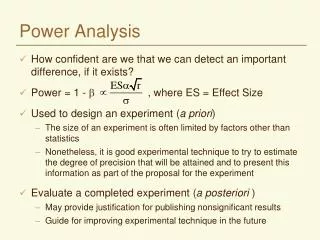
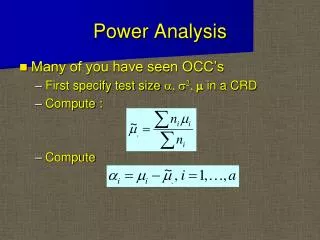
Power Analysis • Many of you have seen OCC’s • First specify test sizea, s2, min a CRD • Compute : • Compute
Power Analysis • Compute a summary measure of Ha: • OCC curves will depend on a, and the numerator and denominator df
Power Analysis • Select the appropriate OCC curve • Find where vertical line drawn fromfon horizontal axis intersects appropriate OCC • Readbon vertical axis; compute1-b
Power Analysis • OCC’s can be used for sample size analysis, but they are awkward • The curves are computed from the distribution of the F statistic under HA
Derivation of OCC’s • Recall that
Derivation of OCC’s • Regardless of the true state of nature, where
Derivation of OCC’s • A non-central c2 rv is often introduced as a sum of independent squared N(li,s2) rv’s; its noncentrality parameter would be: • In our case, the normal components are not independent.
Derivation of OCC’s • We say that F has a noncentral F distribution with noncentrality parameter d2 • A non-central F rv is based on a ratio of independent non-central c2 and central c2 rv’s
Derivation of OCC’s • For the balanced case, we have:
Computer Code • SAS example • R code S02<-rep(seq(1,5),rep(15,5)) n<-rep(seq(2,16),5) ncvec<-n*s02
Computer Code Power<-1-pf(qf(.95,a-1,n*a-a),a-1,n*a-a,ncvec) Contour(seq(2,16),seq(1,5),matrix(power,ncol=5),xlab=“Sample Size”,ylab=“Effect”)
Power Analysis for Contrasts • Magnitude of contrasts under HA is easy for experimenters to articulate (Yandell, Edwards) • We consider one df contrasts only (Yandell focuses on specific cases; our treatment will be more general)
Power Analysis for Contrasts • We will test Ho:L-Lo=0 vs. HA:L-Lo≠0 • Typically, Lo=0 • Regardless of the true state of nature,
Power Analysis for Contrasts • For the balanced case,
Power Analysis for Contrasts • To adapt the SAS program to contrasts, note that the coefficient of n in the noncentrality parameter has changed • Loop on L (not s02) and calculate s02 in the loop • This ensures that L is output rather than s02 • Remember to change numerator df