Overview of MuCh Software: Design, Segmentation, and Timing Algorithms for Straw Detectors
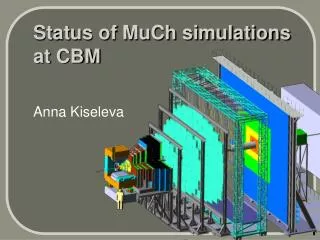
This document outlines the status and capabilities of MuCh software, focusing on its application in the CBM experiment. It includes details on the design of various geometries and segmentations, highlighting algorithms for cluster deconvolution and dead zone effects. Specific statistics regarding absorber and station specifications are provided, along with useful insights into timing algorithms for tracking accuracy. The document serves as a comprehensive report on the MuCh software's functionalities and its integral role in the ongoing collaboration.

Overview of MuCh Software: Design, Segmentation, and Timing Algorithms for Straw Detectors
E N D
Presentation Transcript
Status of MuCh software • Outline • Straws in Much design • Segmentation algorithms • Cluster deconvolution algorithms • Timing in MuCh • Study of dead zone effects Evgeny Kryshen (PNPI) Mikhail Ryzhinskiy (PNPI & SPbSPU)
Three geometry types Module design Straw design Simple design CBM Collaboration meeting @ Split, 7 October 2009
Geometry input file: much_standard_straws.geo # General information MuchCave Zin position [cm] : 105 Acceptance tangent min : 0.1 Acceptance tangent max : 0.5 Number of absorbers : 6 Number of stations : 6 # Absorber specification Absorber Zin position [cm] : 0 40 80 120 170 225 Absorber thickness [cm] : 20 20 20 30 35 100 Absorber material : I I I I I I # Station specification Station Zceneter [cm] : 30 70 110 160 215 340 Number of layers : 2 2 2 3 3 3 Detector type : 1 1 1 2 2 2 Distance between layers [cm]: 10 10 10 7 7 7 Support thickness [cm] : 1.5 1.5 1.5 0.0 0.0 0.0 Use module design (0/1) : 1 1 1 0 0 0 # GEM module specification (type 1) Active volume lx [cm] : 25.6 Active volume ly [cm] : 25.6 Active volume lz [cm] : 0.3 Spacer lx [cm] : 0.5 Spacer ly [cm] : 5 Overlap along y axis [cm] : 2 # Straw module specification (type 2) Straw thickness [cm] : 0.4 CBM Collaboration meeting @ Split, 7 October 2009
Straw visualizer CBM Collaboration meeting @ Split, 7 October 2009
Automatic segmentation Simple design Module design // Number of stations seg->SetNStations(6); // Set minimum allowed resolution for each station Double_t sigmaXmin[] = {0.08, 0.08, 0.08, 0.08, 0.08, 0.08}; Double_t sigmaYmin[] = {0.08, 0.08, 0.08, 0.08, 0.08, 0.08}; seg->SetSigmaMin(sigmaXmin, sigmaYmin); // Set maximum allowed resolution for each station Double_t sigmaXmax[] = {0.6, 0.6, 0.6, 0.6, 0.8, 1.}; Double_t sigmaYmax[] = {0.6, 0.6, 0.6, 0.6, 0.8, 1.}; seg->SetSigmaMax(sigmaXmax, sigmaYmax); // Set maximum occupancy for each station Double_t occupancyMax[] = {0.05, 0.05, 0.05, 0.05, 0.05, 0.05}; seg->SetOccupancyMax(occupancyMax); CBM Collaboration meeting @ Split, 7 October 2009
Manual segmentation Module design Simple design // Number of regions for each station Int_t nRegions[] = {5, 3, 1, 1, 1, 1}; seg->SetNRegions(nRegions); // Set region radii for each station Double_t st0_rad[] = {13.99, 19.39, 24.41, 31.51, 64.76}; seg->SetRegionRadii(0, st0_rad); … // Set minimum pad size/resolution in the center region for each station Double_t padLx[] = {0.1386, 0.4, 0.8, 0.8 ,0.8, 0.8}; seg->SetMinPadLx(padLx); Developed by M. Ryzhinskiy CBM Collaboration meeting @ Split, 7 October 2009
Cluster deconvolution problem CBM Collaboration meeting @ Split, 7 October 2009
Cluster deconvolution Q Qmax Qthr Primary cluster Hit coordinates: Hit errors: Qthr(Qmax) = 0.1Qmax pads CBM Collaboration meeting @ Split, 7 October 2009
Ward’s method Error Sum of Squares: j – cluster index; n – number of elements in the cluster; xi – vector of variables characterizing the element; N – total number of clusters. thr pads • On the 1st step each pad is considered as a cluster consisting of one element (pad); • Calculate ESS for the current configuration; • Group all possible clusters into pairs looking for the minimal difference =ESSnew – ESScurrent. If found, save the new configuration; • Repeat the procedure until thr; Developed by Misha Ryzhinskiy CBM Collaboration meeting @ Split, 7 October 2009
Divisive method • On the first step all pads are grouped into one cluster; • Look for the element which has maximal mean distance between other pads in the cluster; • If found, delete it from the cluster and put in the newly created one; • Look for elements in the first cluster which have maximal difference i and move them to the new cluster until i<0; • Disentangle clusters until Developed by Misha Ryzhinskiy CBM Collaboration meeting @ Split, 7 October 2009
Number of points in clusters 99.5% 97% 89% 10% 3% 0.5% 0.6% 0.05% 0.01% 50% 60% 45% 89% 30% 10% 9% 5% 0.6% • 1- and 2-pad clusters are dominated by one MC-point; • 3- and 4-pad have non-negligible contribution from two MC-points; • 5- and 6-pad clusters have almost equal contribution of one and two MC-points as well as some fraction of 3 MC-points. Developed by Misha Ryzhinskiy CBM Collaboration meeting @ Split, 7 October 2009
Number of points in clusters 1 point 2 points 3 points 4 points May the cluster charge give a hint about the number of tracks? Developed by Misha Ryzhinskiy CBM Collaboration meeting @ Split, 7 October 2009
Timing in digis and hits CBM Collaboration meeting @ Split, 7 October 2009 Semi-realistic timing model has been implemented: • MC time information can extracted from CbmMuchPoints. • Time in digis is defined by Gaussian smearing of the MC time for the first track contributed to the digi. • Hit time is defined as an average between digi times. Hit time dispersion is defined as a sum of digi-time dispersions divided by the number of digis in the cluster. • One can set the digi time uncertainty in the macro with the method: CbmMuchDigitizeAdvancedGem::SetDTime(). • Realistic uncertainty for GEMs is of the order of 2-3 ns. 3 ns are used by default. • Acceptable timing pulls: sigma = 0.89.
Study of dead zone effects Front side Back side Overlap X spacer Y spacer Dead zone CBM Collaboration meeting @ Split, 7 October 2009 No dead zones in y direction Realistic spacer width in x direction ~ 5mm ~ 4% dead zone in x-direction ( ~ 2* 5 / 250 ) Reconstruction requirement: at least one hit between absorbers, three hits at the last trigger station. Reconstruction efficiency is normalized to MC muons from signal J/psi decays. Pure dimuons (without background) are considered
Conclusions and next steps CBM Collaboration meeting @ Split, 7 October 2009 Conclusions: • New much software is working reasonably well. • Many bugs were corrected thanks to the users. • Further tests are necessary (especially with straw option). • Advanced cluster deconvolution algorithms were implemented, but appeared hardly suitable in our case Next steps • Module design for straw stations • Realistic straw digitization and hit finding algorithms (in collaboration with A. Zinchenko) • Further investigation of cluster deconvolution algorithms • Parameter tuning • Waiting for beam test results • Join layout study business