Exponential/ Logarithmic
This guide covers exponential and logarithmic functions, exploring their definitions, properties, and related laws. Exponential functions are characterized by their one-to-one nature and inverse relationships with logarithmic functions. The domain and range are identified, alongside different behaviors depending on the base (a). Key exponential laws are presented, along with examples illustrating logarithmic evaluations and the natural logarithm. Include practical applications such as solving equations and modeling real-world phenomena, like half-life in radioactive decay.

Exponential/ Logarithmic
E N D
Presentation Transcript
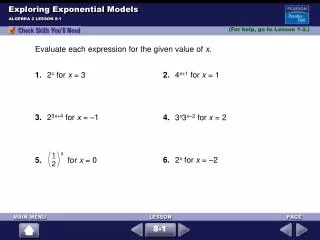
Exponential Functions f(x) = ax Domain (-∞, ∞) Range (0, ∞) Three types: 1) if 0 < a < 1 2) if a = 1 3) if a > 1
Laws of Exponents a x + y = ax ay ax/ ay = a x –y (ax)y = axy (ab)x = axbx
Sketching Example Sketch the function y = 3 – 2x
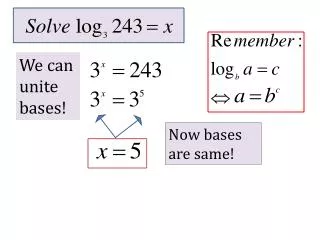
Exponential Functions are One to One Has an inverse f-1 which is called the logarithmic function (loga) f-1(x) = y f(y) = x ay = x logax = y
Example Find: log10(0.001) log216
Log Graph Reflection of exponential function about the line y = x Domain (0, ∞) Range (-∞,∞)
Laws of Logarithms loga(xy) = logax + logay loga(x/y) = logax – logay logaxr = rlogax
Example Evaluate log280 – log25
e y = ax Many formulas in calculus are greatly simplified if we use a base a such that the slope of the tangent line at y = 1 is exactly 1 For y = 2x, slope at y = 1 is .7 For y = 3x, slope at y = 1 is 1.1 Value of a lies between 2 and 3 and is denoted by the letter e e = 2.71828
Example Graph y = ½ e-x – 1 and find the domain and range
Natural log (ln) Log with a base of e logex= lnx lnx = y ey = x
Properties of Natural Logs ln(ex) = x elnx = x ln e = 1
Example Find x if lnx = 5
Example • Solve e5 – 3x = 10
Example • Express ln a + ½ ln b as a single logarithm
Expression y = logax ay = x ln ay = ln x y ln a = ln x y = ln x/ ln a logax = ln x/ ln a if a ≠ 0
Example • Evaluate log85
Example • The half-life of a radioactive substance given by f(t) = 24 ∙ 2-t/25 Find the inverse