Angular Motion
This guide explores the relationships between linear and angular motion, focusing on conversions and the acceleration of objects in rotational motion. It covers the formulas for converting linear measurements to angular (and vice versa), detailing how arc length relates to radius and angle in radians. The right-hand rule is introduced for determining acceleration direction. Additionally, the guide touches on key concepts like the parallel axis theorem and the properties of dot and cross products in physics. Perfect for students and professionals interested in dynamic mechanics.


Angular Motion
E N D
Presentation Transcript
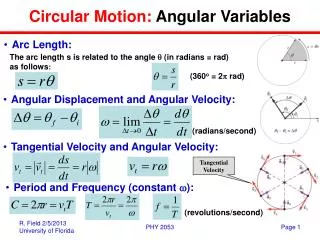
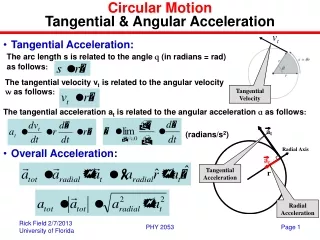
x • Where x = arc length • Θis the angle • r is the radius of the circle • Linear to angular • (Θis in radians) • To get into degrees:
1 Revolution = 2π(rad) = 360 deg
Right Hand rule • To figure out the actual acceleration of an object you place your and in the same way of the rotation (cuffing your fingers).The way in which your thumb points outward is the angle in which the object is accelerating.
Dot and Cross Products c Cross products ARE NOT commutative
Parallel Axis Theorem • General Format: Where is **from last slide