Download
1 / 13
130 likes | 277 Vues
This overview explores various receptor types and their signaling mechanisms, focusing on ion channels and intrinsic enzyme activities. It examines serine/threonine kinases and tyrosine kinases, highlighting their roles in cellular proliferation and anti-proliferative functions. The interaction of ligands like TGF-B1 and Atrial Natriuretic Peptide with their corresponding receptors is discussed. Furthermore, it explains the significance of guanylate cyclase in regulating blood pressure and its clinical relevance, including treatments for conditions like angina.

E N D
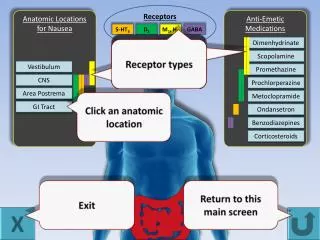
Types of receptors... • Ion channels • Intracellular • Intrinsic enzyme activity • Soluble protein kinases • G-protein linked
Intrinsic enzyme activity • 2 examples • Serine/threoninekinases • Tyrosine kinases
Serine/threoninekinases • These have an ANTI-PROLIFERATIVE to the cell in general • Work through SMAD proteins Ligands: • Transforming growth factor B-like TGF-B1 • Activins • Bone morphogenetic proteins BMPs
Ser/thr cascade • Inhibitory growth factor binds to receptor • Binding causes the receptor to dimerise • Activated receptor can now phosphorylate SMAD proteins • SMAD-P now joins with co-SMAD and can travel to the nucleus • Talks with some transcription factors and allows the transcription of the right genes
Tyrosine kinases • These have a PROLIFERATIVE effect on the cell in general • Works through Ras Ligands: • Over 50 identified • Lots of growth factors GFs • Insulin
Tyr cascade • Growth factor binds to the receptor • Binding causes the dimerisation of the receptor • Activated receptors now able to phosphorylate themselves • Receptor-P now able to bind the adapter molecule carrying Ras-GDP (inactive) • Nucleotide exchange occurs GDP swopped for GTP = Active Ras
There is another receptor with intrinsic enzyme activity he talks about... • Guanylatecyclase • This is your classic VASODILATOR cascade one Clinical relevance question wise • Blood pressure • Angina • Erections
Guanylatecyclase • For blood pressure where Atrial naturitic peptide ANP is released • Activates guanylatecyclase • Causes conversion of GTP to cGMP • cGMP activates protein kinase G PKG • PKG causes • Vasodilation • Increased sodium and urine production (getting rid of fluid to lower blood pressure) • Phosphorylation of sodium channels to reduce reabsorbtion again making more urine to be lost, lowers blood pressure
Guanylatecyclase • This time using ANGINA as the issue • As a treatment for this the patient can use a GTN spray – which basically gets Nitric oxide (NO) into the body • NO activates guanylatecyclase and causes the same cascade as before • GTP cGMP PKG vasodilation
As always, just give us an email if something isn’t clear/need more pointers!! xxx