
SlideServe
Menu
Préférences
© SlideServe · v2026

Signalling

ugo avatar
39 diapositives · 539 Views · Jul 30, 2014

This chapter covers key concepts in signal processing, including the principles of sampling, digitizing, and the challenges encountered in digital signal transmission. It discusses how digital signals are less affected by noise, the importance of selecting the correct sampling frequency, and the implications of insufficient sampling rates. The chapter also explains signal transmission methods and how digital data is sent effectively using techniques such as multiplexing and awareness of bandwidth. Engaging activities and demonstrations enhance the understanding of these essential digital communication concepts.
Signalling - slide 1
01 / 39Signalling
1 / 17

Télécharger la présentation

Signalling
Une image / un lien ci-dessous est fourni (tel quel) pour télécharger la présentation

Politique de téléchargement : le contenu du site vous est fourni TEL QUEL pour votre information et votre usage personnel ; il ne peut être vendu, concédé sous licence ni partagé sur d’autres sites sans l’accord de son auteur.Le contenu vous est fourni TEL QUEL, pour votre information et votre usage personnel uniquement. Téléchargez la présentation en cliquant sur ce lien. Lors du téléchargement, si vous ne parvenez pas à télécharger une présentation, l’éditeur a peut-être supprimé le fichier de son serveur.Pendant le téléchargement, si vous ne parvenez pas à obtenir une présentation, le fichier a peut-être été supprimé par l’éditeur.

F I N

Plus de contenu associé

Transcription de la présentation
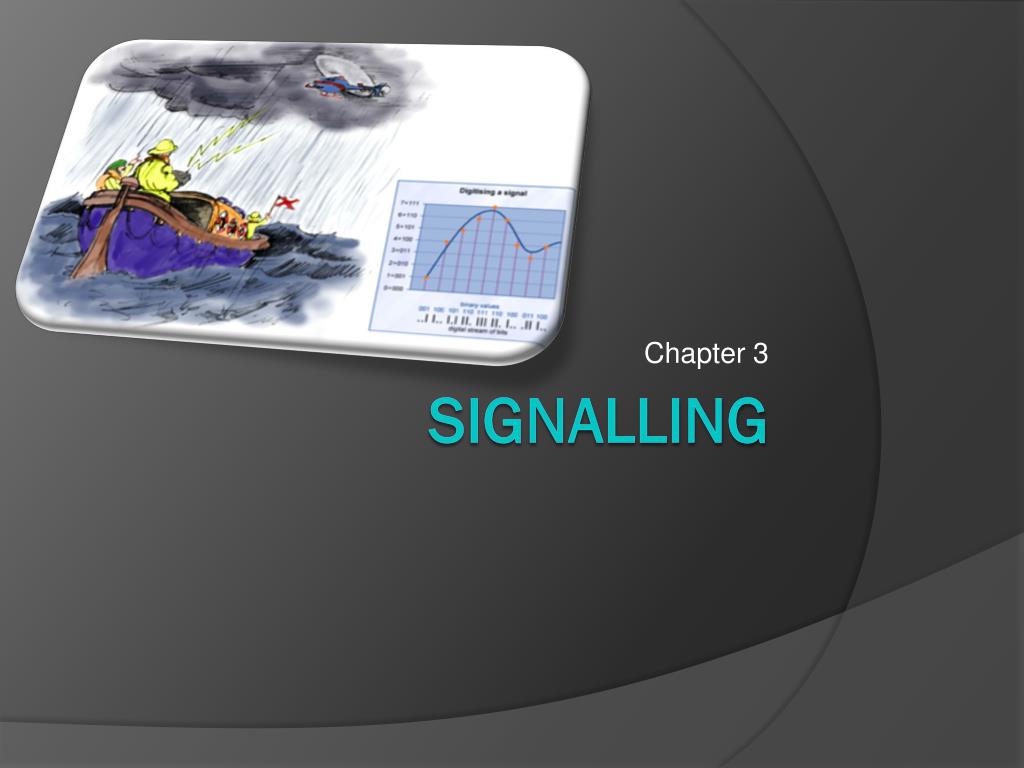
  1. Chapter 3 Signalling

  2. Lesson Objectives

  3. Equations

  4. Chapter 3.1.1 Sampling and digitising 1

  5. Signals and Noise Digital Signals are much less prone to interference and so I theory should produce higher quality signals e.g. Digital TV and Radio

  6. Sampling 1 Instead of storing a whole waveform a signal can be sampled (digitised) at regular intervals. As long as the signal is sampled at a high enough frequency the original signal can be reconstructed

  7. Sampling Problems 1 If you sample at the wrong frequency then the original signal cannot be reconstructed accurately . The optimum sampling frequency is: 2x the highest frequency in the original signal e.g. a music CD need a highest frequency of 20kHz to be stored so music is sampled at 44.1kHz.

  8. Sampling Problems 2 Another problem is that if you sample at too a low frequency then spurious frequencies called aliases can be created in the reconstructed signal

  9. Wheels moving backwards You have probably seen this effect on TV or the cinema when a car moving forwards appears to have wheels that are rotating backwards

  10. Software Demo • Looking Less Often • Activity 70S

  11. Digitising Signals can be digitised by turning the sampled waveform into numbers. Sampling is done using an analogue to digital converter (ADC) A Digital to analogue converter (DAC) can reverse the process The diagram on the left shows that with 3 bits of information up to 8 levels can be stored (3 bits = 8 possible binary numbers) Using more bits means more levels and a greater resolution A telephone uses 8 bits = 256 levels for each sample A high quality CD uses 16 bits = 65536 levels for each sample

  12. Chapter 3.1.2 – 3.1.3 Sampling and digitising 2

  13. Signal Transmission A fax converts text and pictures into pixels one line at a time. This is slow and requires a lot of data to be transferred Slow information transfer rate

  14. Signal Transmission E-mail sends less information per page because it can encode letters as numbers instead of pixel by pixel. This means a faster information transmission time even if we use the same transmission rate (64000 bits per second) as the fax machine

  15. Chapter 3.2 Signalling with EM Waves

  16. Sending digital data 1

  17. Sending digital data 2

  18. Waves all around Look at the size of TV aerials on the roofs of houses - they give you and idea of the wavelengths being received . Usually the rods are half a wavelength long – a few cm

  19. TV Ariel's The rods are a few cm long indicating that it is designed to receive waves with wavelengths of a few cm

  20. Chapter 3.2.2 - 3.2.3 Polarisation

  21. Polarisation TV and Radio waves are polarised To pick up a signal the receiving rods must be parallel to the electric field oscillations of the wave Again looking at TV aerials will tell you the direction of polarisation

  22. TV Ariel's The short Transverse rods indicate that this ariel is designed to receive waves that are horizontally polarised

  23. Chapter 3.2.3 Frequency Spectrums

  24. Making Music If you are a Jazz Maverick and Electro-pop superstar its important that you know how to process sounds and music…

  25. Oboe

  26. Clarinet

  27. Xylophone

  28. Snare Drum

  29. 1000Hz Pure Tone

  30. 1000Hz and 3000hz combined

  31. White Noise

  32. Software Demo • Cleaning up a sound • Activity 210S

  33. Chapter 3.2.4 Multiplexing and Bandwidth

  34. Bandwidth

  35. Software Demo • Bits per second and bandwidth • Activity 260S

  36. Bandwidth and sampling