Download
1 / 16
160 likes | 294 Vues
The Byzantine Empire, or Eastern Roman Empire, thrived from 330 to 1444 AD amidst the chaos of the Western Roman world's decline. Characterized by its wealth and stability, it was marked by notable figures such as Justinian I, who reformed Roman law with Justinian's Code and commissioned the grand Hagia Sophia. The empire developed a unique form of Christianity that led to the Schism of 1054, separating Eastern Orthodoxy from Roman Catholicism. The Byzantine cultural legacy has profoundly influenced Slavic nations and preserved ancient Greek and Roman traditions.

E N D
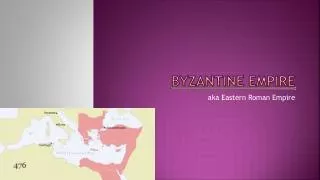
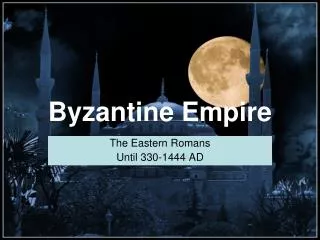
Byzantine Empire The Eastern Romans Until 330-1444 AD
Germanic invasions devastate the Western Roman world. Rome sacked in 476 AD. • Western Rome becomes decentralized. • East is rich and stable until 1444. Mix of Greek, Roman, and Asian…
Justinian I • Absolute ruler-autocrat • Awesome General Flavius Belisarius snags Italy back in 530 AD (lose it) • Builds Hagia Sophia* after Nika Rebellion* in 532 AD • Reformed Roman law= Justinian’s Code • Why he lasted? His wife.
Hagia Sophia • “House of Wisdom” in Constantinople • Domes and arches • It would remain the largest built until the 1500’s
Empress Theodora Θεοδώρα • “actress”, daughter of a bear trainer • Own policies-helped Justinian • Laws to protect poor women • Nika Rebellion of 532 AD • Read her quote
Byzantine Christianity before 1054 • The Byzantines practiced Christianity differently than the West: • Mass in Greek, priests can marry • No Pope…Emperor in charge, picked a “patriarch” • Byzantine patriarch rejects* Icons (religious images used for worship)
Schism 1054 • Creates a permanent break in the world of Christianity between west and east • The Schism of 1054 • West=Roman Catholicism • East=Orthodox Christianity
Iconoclasm abandoned in the ninth century—the breach, never healed.
Legacy of Byzantines: • Byzantine culture important- preserved Greek and Roman culture while the West decentralized • Byzantine culture and religion had enormous impact on Slavic culture, especially the Russians* and Greeks • Cyrillic! Cyril and Methodius invent alphabet • Czar…Caesar, Eastern Orthodoxism
Byzantine Culture • Elaborate, detailed • Remained heavily influenced by Asia • Mysterious to Western Europeans • “Byzantine” in English interpreted as complex, intricate, devious*
Directions for today… • Look again at the Cyrillic Alphabet. • Answer the following questions: • 1. Why was the alphabet created? • 2. Who do you think created it? • 3. How is this alphabet a PERFECT example of “cultural diffusion”?
Another cool question… • 1. What is the structure shown in the background? • 2. What is it called? • 3. Can you think of how this structure ALSO is a perfect example of “cultural diffusion”?
Your last TASK today… • 1. Answer the following fun, practice quiz. • 2. Decide what the state of New York thinks you should know about the Byzantines…make a list of 5